Talking With Your Friends About Meditation

Meet Chanel, a YA living in Windsor, CA.Chanel has tried different approaches to share passage meditation with friends and family and reflects here on her endeavors.

Chanel.jpg

I find the best way to present meditation to my friends is "social osmosis" if you will, or leading by personal example. As I deepen my spiritual practice, my friends may naturally flow the same way into meditation. I also feel this theory holds up when meditating with others.  If I am practicing patience, those around me may notice and want to be more patient themselves. If I am training my senses, those around me could be aware and perhaps put down their box of red velvet cupcakes because they know it would behoove them to train their senses too. Essentially, I am talking about moving from low levels of patience, kindness, forgiveness to a higher capacity, and emanating those qualities to a degree that benefits others, and maybe even inspires them to do the same.

     I have been lucky enough to share meditation with a few of my best friends and family members. Some of them have implemented certain parts of the eight-point program into their lives. For example, one of my oldest friends is a yoga teacher and she has integrated passage meditation into her yoga classes. She is also an artist and has been exploring some brilliant creations of mantram art. One of my roommates in college is of the Sikh religion. She has molded meditation into her religious practice. Another one of my close friends has read several Easwaran books, attended weekly satsang and even a retreat. She is learning the importance of implementing the eight points simultaneously. She has also incorporated the mantram into her daily life. A few of my cousins have started reading the books. Even my dad has read Passage Meditation and has begun to meditate, albeit rather sporadically.

Chanel-duo1.jpg
Chanel-duo2.jpg
Chanel-duo3.jpg

Chanel (left) gets creative sharing passage meditation books with friends. Using traditional routes she'll give them as gifts or, using the stealth approach pictured above, she'll just read conspicuously near a friend!

Conversely, some of my friends have not taken to meditation no matter how many Easwaran books I casually slip into their bag or conceal as birthday gifts. Which brings me to my next strategy: let Easwaran do the talking. Whenever someone comes to me and is interested in mediation, I give them none other than the text of Passage Meditation. I believe it is best for them to learn it from the man himself. I have also found that Strength in the Storm is another essential book for interested parties to read because it shares a great deal of real-life stories from meditators. My mom is the one who introduced Passage Meditation to me. She had the book on our bookshelf for several years and one day I just picked it up and started reading. Easwaran's words captivated me like no other book had. Overall, it has been my experience that the people in your life will come around to meditation when and if they are ready. For each of my friends and family, it has always been a certain time in their lives where they are searching for something real. They come to the conclusion on their own, I just have the books on hand (you never know when it may happen). I am cautious never to force or boast about meditation. It is a certain subtlety of being, I believe, that inspires those close to you.

    Above all, it is a wonderful gift to be able to share meditation with your friends. However, you do not have to get your friends involved just to feel comfortable with having a mediation practice. The Young Adult eSatsang is full of genuinely incredible people with open minds and open hearts. We have a supportive community of friends that help each other, give advice, and share stories. I am reminded of a metaphor Sri Easwaran once wrote about in relation to rock climbing (forgive my attempt to articulate extreme sports as I am not an expert by any means). I remember something he said about being strapped to another person while rock climbing. If you reach for a rock and slip there is someone there to make sure you do not fall. That is how I feel about sharing meditation with others. If I am having trouble or feel like I might slip, there is someone there to make sure I do not fall. In an enigmatic way, our minds and souls are connected in the journey to our Selves.

Chanel-2.jpg

Chanel (left) has shared passage meditation with a number of friends and family. This photo shows Chanel and one of those friends at a recent YA retreat.

In my opinion, fellowship is so much more than just talking to your friends about your meditation practice. You build a friendship with your sense of Self, your state of being, as well as all the other meditators around the world who know exactly what you are embarking on.

For all of you that have just begun to meditate or are even considering it: I think this is the beginning of a beautiful friendship.

Tips for Meditating on the Road

Meet Adam, a YA from San Francisco. Like many of us in our 20s and 30s, Adam spends a lot of time traveling and has developed many tips for how to keep up a passage meditation practice while on the road.

Adam.jpg

Meditation is hard enough at home and under ideal conditions – so how do we expect ourselves to keep it up when we're on the road and off our normal schedule?

I started as a very socially anxious person. So camping recently with a group of non-meditators in Yosemite, I felt familiar pangs:  What will they think of me? Will I miss important group time? Will waiting for my meditation be an inconvenience for the group? In the past these worries would have had me quivering. But meditation has given me armor against such enemies, strengthening me to "come out of my cocoon" as a fellow YA said beautifully on the YA eSatsang recently. Camping that weekend, I remembered Easwaran’s refrain:

“Put meditation first.… Nothing important will ever suffer by this”

I woke before the group and enjoyed beautiful sunrise meditations. Early in the day I told my friends about my plan for evening meditation, and when the time came I meditated while others lounged and recovered from a hike. “Wow,” I thought, “as usual, Easwaran was right!” I felt refreshed, and my friends ranged from neutral to inspired.

YA-Adam-Bike.jpg

My actions to make that weekend’s practice go smoothly sound simple, but for me they’ve been the result of years of slow progress. Making meditation work on the road – like most of the challenges of growing our eight-point practice – has been all about (1) the BIG stuff: building habits through repetition, and (2) the little stuff: ironing out lots of details.

The BIG stuff: building habits through repetition

1.       Be proactive about informing others

For me, the social aspect has been the hardest part of making meditating work when I'm off my usual schedule. For years I felt embarrassed to be seen meditating. I was embarrassed to tell people that I would be meditating – friends, coworkers, new acquaintances, just about anybody. I thought it sounded weird. And worse, I was anxious I'd somehow disappoint them by stepping out for 30 minutes or changing plans that would affect other people.

I found the key to overcoming this anxiety is simple: be honest and direct about telling people that I meditate. Now I plan and communicate ahead of time so it’s not a surprise when I step out. Not only does this help reduce my anxiety, but people respond positively when I tell them. Just letting folks know beforehand makes all the difference.

2.     Just do it! But how?

  • Wake up early. Whether on the road or at home, wake 35 minutes before you'd otherwise need to start your day. If you can make this a “given” in your own mind – meaning you know you'll always do it, no matter the circumstances – you'll never miss a day of meditation, whether you had to catch a flight to a different time zone, or were simply out later than you'd like celebrating a friend's birthday. But waking early is hard at first and takes practice! If we do what we can on our part – being determined, patient, and forgiving with ourselves – sleep habits will gradually change.
  • No meditation, no breakfast. Strike this bargain with yourself and you won’t forget to meditate, Easwaran advises. I apply a similar bargain to evening meditation: don't go to sleep ‘till it's done. First thing in the morning and early evening may be better for meditation, but can be hard to achieve when traveling. Much better late than never! When my mind starts to chatter about not getting enough sleep, I remind myself that being tired will motivate me to go to bed early tomorrow. And I'm comforted by Easwaran's calm replies about missing sleep: e.g., “instead of getting anxious about how much sleep you're missing or how you will feel in the morning, repeat the mantram.”

The little stuff: Below are ideas for a few of the many details involved in making meditation work away from home.

Places to mediate:

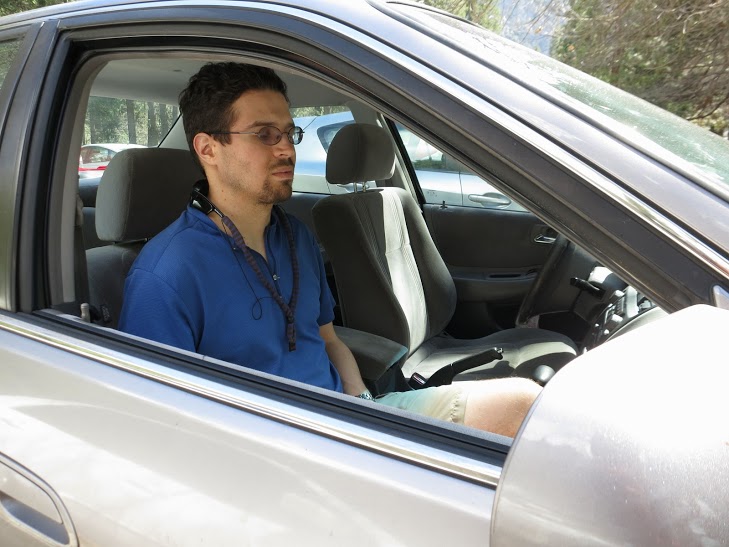
  • A parked car can be an excellent meditation room on the road. The front seats tend to be highly adjustable, and with doors shut you get decent sound protection. I bring a jacket and hat in case it's cold. :-)
  • Hotel rooms, airplanes, libraries, and churches/temples are also excellent spots.
  • If in a hotel room or friend’s home, find your meditation spot soon after arriving to eliminate last-minute stress. Even when traveling, keep your meditation spot special by using it for nothing else.
YA-Car-Meditating.jpg
YA-Hotel-Room-Meditation.JPG

Body position:

  • I travel with a jacket or sweater to roll up and put behind my lower back. With that, I can transform most any chair into an excellent meditation spot. It keeps my lower back supported while leaving my upper back free and upright, which helps me stay alert.

Noise:

  • Consider traveling with earplugs or sound-reduction earmuffs.

Timing (how to know when 30 minutes have passed):

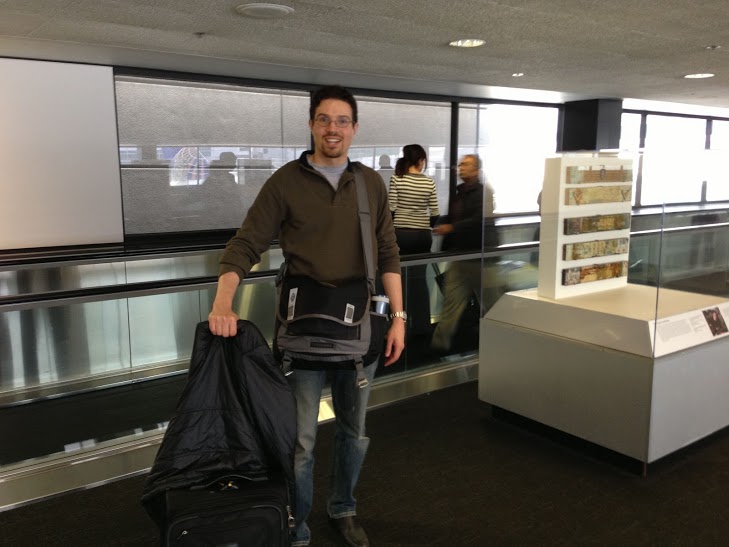
  • It's useful to get familiar with how to turn on a few features of your phone: (a) airplane mode, (b) alerts silent (e.g., "Do not disturb" mode on iPhone and "Silent Mode" on Android), and (c) vibrate timer on. That way, you can set a vibrating meditation alarm when quiet is needed or earplugs are in, and you won't be disturbed by calls or alerts.
YA-Airport.JPG

Finally, please remember that travel can also be a special opportunity. Away from the demands of our usual time and place, travel can be reconceptualized as a spiritual retreat. Flying to Los Angeles for work today, I remembered a video where Easwaran described repeating his mantram throughout an entire short flight. Inspired, I dedicated my flight to my parents and set in memorizing a new passage. What joy to discover I had my own temple in the clouds! And the Self seemed so clear in the face of each neighbor and in the mountains and even cities below.

I'm learning to be patient and proud of myself for my efforts and for wanting to meditate even under tough circumstances. I know that together, our little efforts are building a spiritual renaissance!

What are your tips for how to make meditation work when you're on the road or time is tight? Feel free to share using the comment button below – it'd be fantastic to hear from you!

It Takes Work But It's Worth It

Meet LB, a YA living in Chattanooga, Tennessee.​ Reflecting on both the effort it takes to maintain a regular passage meditation practice, and the benefits of the practice, LB has found that the work is more ​than worth it!

​

began meditating in the summer of 2008, when I was 23. I had had no prior experience of meditation, but I was eager to deepen my spiritual awareness. The previous eighteen months of my life had been some of the most spiritually and emotionally difficult I'd ever known. Depression had often drained my passion for life during that year and a half, and my recent marriage had already suffered some heavy blows, due largely to my own seemingly intractable selfish attitudes and behavior. Fortunately, during the spring of 2008 I experienced a powerful breakthrough as a result of some work I had done with a spiritually-focused group dealing with addictions, work that paved the way for my introduction to meditation.

One day, a friend in the group who knew I was seeking a method of meditation suggested I read a book by someone named Eknath Easwaran. The book was called, simply, Meditation, and I ordered it online soon after my friend mentioned it to me. When it arrived, I opened it with the same giddy anticipation I always have when I receive a new book. It was small and clean, with a glossy cover and a subtitle—A Simple 8-Point Program for Translating Spiritual Ideals Into Daily Life—that told me I was on the right path. Before I opened the book I told myself that, because I knew nothing about meditation, I would approach Easwaran's words with open-mindedness and a willing spirit, seeking to follow as closely as I could the instructions he presented. (Thankfully, the spiritual group I had been a part of placed great emphasis on these qualities of openness and willingness, so I was well-prepared in that way). I opened the book, and discovered in its pages a voice that has become very dear to me on my spiritual journey; it was, and is, the voice of a wise and encouraging friend, a voice as full of light and humor as it is of deep sincerity and clay-footed practicality. Perhaps most importantly for me, it was a voice of unshakable certainty built on direct, personal experience—not on theories or dogmas or speculation. Here was one whose statements about the spiritual life could be trusted, and who offered practical guidance to those like me who lived an active life in contemporary society.

YA-Passage-Meditation-Book.jpg
LB-Walking-YA.jpg

The first instruction that stood out to me stressed the importance of daily meditation. As Easwaran puts it: “There is only one failure in meditation: the failure to meditate regularly.” Reading that, I resolved to be faithful and consistent in my practice, and through some mysterious mixture of effort and grace I have been able to meditate every day without lapse for a little more than four years now. So what does my daily practice look like? Most mornings my alarm clock goes off at 6:15. Within a minute or two I am out of bed, slipping on a sweatshirt if it's cool weather. Grabbing my keys, I slip on some shoes and head out the back door into the faint light of early morning. Still a bit bleary, I stroll down the driveway, glancing at the morning paper lying in the grass, and go for a short walk down the street and back. In the past, I would have simply rolled out of bed and gone straight to my meditation corner. But after many, many groggy, half-conscious mornings I decided, at the suggestion of a fellow passage meditator, to begin the day with this short walk to wake me up and get some blood flowing. The birds are up with me, and I listen to them sing as I walk. Sometimes the neighborhood barred owls call across the tree tops, hooting from their invisible perches. Returning to my driveway, I grab the paper and head to the backyard to see about my three chickens. I let down the ramp that keeps them closed in at night, gather the eggs from the nesting box, and go back inside.

Putting the eggs and newspaper on the counter (taking a minute to scan the headlines), I pick up my cell phone, which I use as a timer, and make for my meditation corner. My meditation bench, along with a small soft blanket, leans against the wall where I placed it after the previous morning's meditation. Rolling out the blanket, on which I will rest my knees, and unfolding the legs of the meditation bench, I find a comfortable position near the window that looks out onto the front yard. Once I am settled, I grab the little notebook into which I copy passages I want to memorize for meditation along with a copy of Sri Easwaran's God Makes the Rivers to Flow, a diverse collection of inspirational passage suitable for memorizing. I spend a few minutes reviewing the passage (or passages) I plan to use for that day, plus any new passage I am trying to memorize, then setting the books aside, I set my phone for thirty minutes, close my eyes, take a breath, and begin silently repeating the passage in my mind. Before long, distractions commence, followed by diligent recollection of the passage. This pattern continues for the duration of the half hour. When the alarm sounds, I open my eyes, silence the alarm, say a few short prayers, and put away the bench, blanket, and books until the next morning.

LB-Meditation-Corner.jpg
LB-Notebook.jpg

A few words on making progress in meditation: one of the best pieces of advice I've received from the writings of Sri Easwaran is that progress should be measured not by startling interior visions but by the ability to be peaceful, loving, and tolerant; not by whether I can hear the cosmic sound, but by whether I can listen to my wife (or friends, or parents...). From this perspective, I can easily see I have made much progress, though I've never had a vision nor heard any sound during meditation but the barking of the neighborhood dogs and the singing of the birds, along with the occasional roaring motorcycle or thundering airplane. An equally important bit of advice is that the rate of progress is a matter of individual needs and abilities and should not be used as a point of comparison. As Easwaran puts it in his three-volume collection The Bhagavad Gita for Daily Living: “We should never ask ourselves why there is...difference between people. It is good to be content with the speed at which we are able to go because it is in accordance with our dharma.” When I remember that my path was tailor-made for me, crafted to teach me exactly the lessons I need to learn in this life, the need to compare myself with others falls away, and discouragement and despair are replaced by hope and serenity.

LB-Carrots.jpg

During the last nearly five years I have experienced wonderful spiritual growth (at my own pace, of course), and meditation is at the core of a host of practices that have contributed to this development. I continue to participate in the group that helps people with addiction, and my involvement offers me abundant opportunities to give my time and energy in service to others. I have learned that working for the benefit of other people without any desire for personal gain is an essential part of my spiritual program, keeping me from becoming too inwardly focused and giving my life a deep sense of satisfaction and purpose. My zest for life has returned with interest, and I now take great pleasure in everyday activities like cooking, eating, hiking, reading, and spending time with family and friends, in addition to getting involved in a few of the many worthy efforts to restore balance and harmony to our relationship with the earth. Most importantly, my capacity for patience, kindness, forgiveness, peace, and happiness has grown. My wife, who spent her first few years of married life with a distant, self-obsessed, judgmental spouse, has recently remarked that having me in her life has made her a better person. If that is true, it is only because of meditation and the other spiritual disciplines that others have taught me, which is to say that purpose, peace, passion, and joy are available to anyone willing to put in the effort.