Applying Passages To Difficult Situations

Could a passage help a difficult work relationship? Abhijeet, a YA living in Tomales, California, answers "Yes!" and shares some of his strategies in this post. 

Abhijeet.jpg

One of Easwaran’s aphorisms that has always intrigued me is “obstacles are opportunities for growth.” I would like to share how inspirational passages helped me in a work-related situation. In my previous job, I was a part of an amazing team of engineers. All of us came from different cultural backgrounds, and although we enjoyed each other's company, as Easwaran would say, there were many opportunities for “rubbing off each other’s angles and corners.” In one such project, I was working closely with a guy who was not easy to get along with. Our style of communication was quite different and I felt that there was always a palpable tension between us. Understandably, this did not make work fun and I felt very challenged and resentful. One of Easwaran’s aphorisms that struck a chord with me was “You and I are on one side and the problem is on the other side." However, I did not have a clue about how I could practically implement this aphorism or try it out in daily life.

The answer came in the form of meditation on an inspirational passage. I had heard Easwaran describe an amazing example of how the inspirational passage can be used as a peg to drive out negative and deeply conditioned thought patterns. The neat thing about inspirational passages is that they enabled me to substitute those negative thoughts and emotions with much higher and positive ones. I had something to hold on to when my mind was spewing negative thoughts at an alarming rate. I learnt that I had no control on the external events but as Easwaran says, I could train my mind to respond calmly rather than reacting to the events that unfolded.

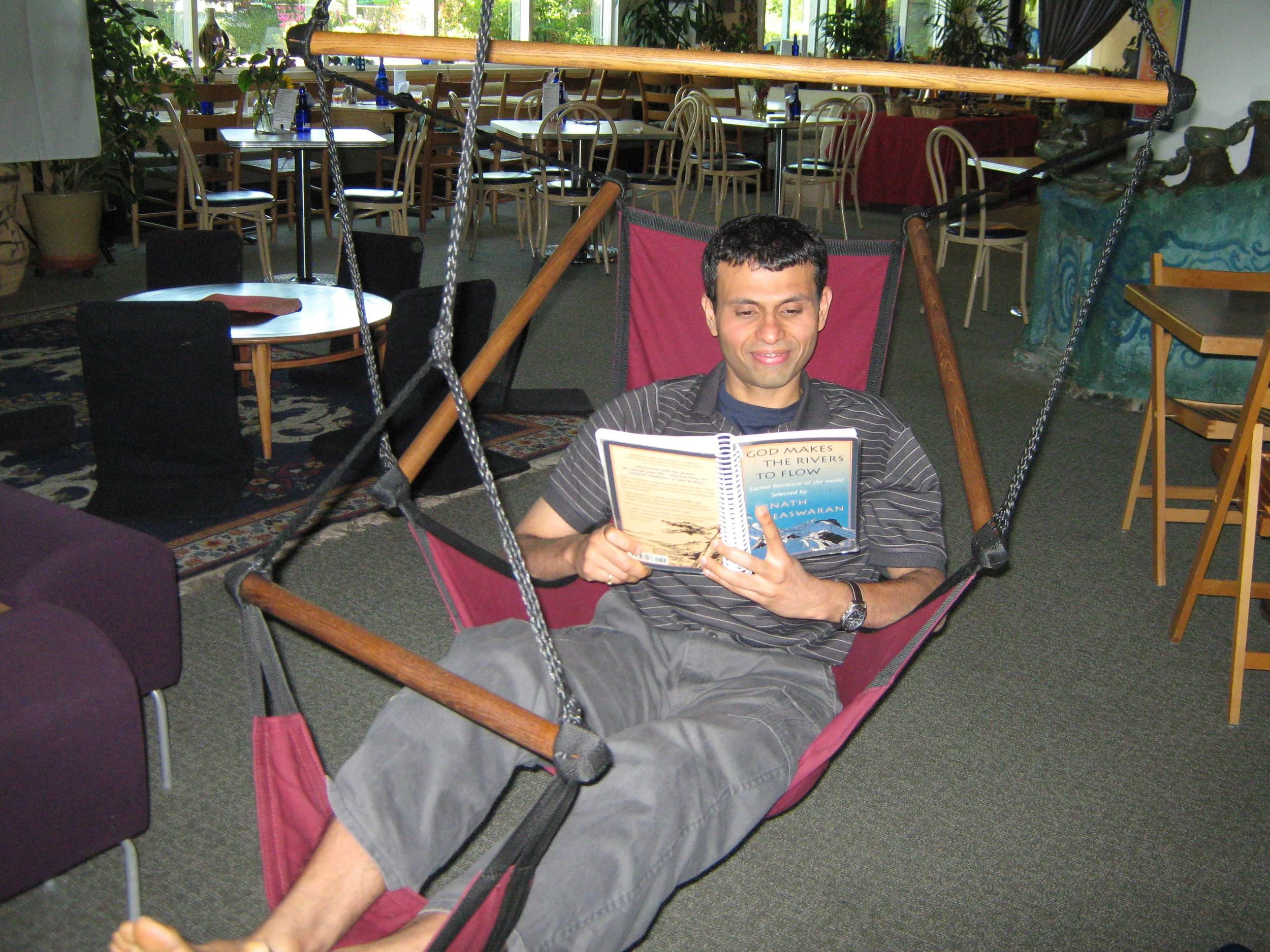
I browsed through God Makes the Rivers to Flow, which is an anthology of inspirational passages ideal for meditation. It was like seeking a wise counselor or friend who had the answer to my challenging situation. Towards the end of God Makes the Rivers to Flow is a section titled ‘Using Inspirational Passages to Change Negative Thinking.’ After going through that section, I short-listed a few passages that appealed to me – Discourse on Good Will, Evening Prayer for the Sabbath, and Whatever You Do.

Abhijeet-YA.JPG
Abhijeet2.JPG

These passages reminded me of the qualities I wanted to cultivate in dealing with my situation at work. I started to memorize them, and used them one by one in my morning meditation.

A couple of those passages were available in the mp3 format from the Easwaran.org website so I downloaded them on my iPod and listened to them on the bus to work.

Abhijeet-Desk.jpg

Before starting my work day, I would take 10 minutes to write a part the passage as a way to commit it to memory. The words of the passage would remind me to look for positive qualities in my colleague and myself. When I would get upset during the day because of an interaction with him, I would come back to my desk and read the passages I had posted next to my computer screen.

I wrote stanzas from those passages on flash cards so that I could continue memorizing them and also read them when I needed inspiration, support, guidance and wise counsel.

I remember one challenging day when nothing seemed to be going well and I was truly disappointed. A thought of taking my colleague out to an Indian restaurant and ordering super spicy food for him crossed my mind! Part of it was coming from trying to inject humor in the situation, and part of it was coming from trying to get even. However, these words from the passage came to my rescue – “Let no one deceive another, let no one anywhere despise another, let no one out of anger or resentment wish suffering on anyone at all.”

The passages taught me that the best way to get even was to actually try to get to know my colleague a little better. Every day, I started making an attempt to converse with him about something other than work. I noticed that he had pictures of his family in his office, so I started asking him about them. For a long time, I felt that nothing was changing. When I returned home, I used to sit on my meditation cushion and meditate on the “Evening Prayer for the Sabbath” for my evening meditation. Here is an excerpt from this passage that gave me a lot of solace –

“I must do my allotted task with unflagging faithfulness even though the eye of no task master is on me. I must be gentle in the face of ingratitude or when slander distorts my noblest motives. I must come to the end of each day with a feeling that I have used its gifts gratefully and faced its trials bravely.”

I would list out the positives from the day on a sheet of paper and place them on my altar.

Abhijeet-Meditation.JPG
Abhijeet-altar.JPG

Gradually, over a period of time, things started shifting a little. I learnt that he was a good family man who loved his wife and children. He also liked American football. Although I knew nothing about this sport, I started asking him more about the rules, the games during the football season, and his favorite players. It was quite refreshing as I realized that amidst all the challenges and our differences, there was some human connection. I also started enjoying listening to how he spent his time with his family on the weekends.

We worked on the project together for more than 6 months and I confess that our differences did not completely disappear. Yet the passages helped me see many positives in my colleague, myself, and our project too. Our working relationship improved over the course of those six months. I was truly amazed by the power of the passages and the benefits of meditating on passages. In the past, I would have fallen sick under the stress and lost hope. However, this time I somehow managed to conduct myself rather well under the circumstances. When I would get agitated before, during and after meetings, I used the passage, Whatever you do – “Whatever you do, make it an offering to me, the food you eat, the worship you perform, the help you give, even your suffering.”  Thanks to the powerful words of the inspirational passages and the eight-point program, I got a lot of comfort and support when I needed it.

Most of all, the passages became my buddies and I felt that I could hang out with them whenever I needed to. 
Abhijeet-Buddies.JPG

Talking With Your Friends About Meditation

Meet Chanel, a YA living in Windsor, CA.Chanel has tried different approaches to share passage meditation with friends and family and reflects here on her endeavors.

Chanel.jpg

I find the best way to present meditation to my friends is "social osmosis" if you will, or leading by personal example. As I deepen my spiritual practice, my friends may naturally flow the same way into meditation. I also feel this theory holds up when meditating with others.  If I am practicing patience, those around me may notice and want to be more patient themselves. If I am training my senses, those around me could be aware and perhaps put down their box of red velvet cupcakes because they know it would behoove them to train their senses too. Essentially, I am talking about moving from low levels of patience, kindness, forgiveness to a higher capacity, and emanating those qualities to a degree that benefits others, and maybe even inspires them to do the same.

     I have been lucky enough to share meditation with a few of my best friends and family members. Some of them have implemented certain parts of the eight-point program into their lives. For example, one of my oldest friends is a yoga teacher and she has integrated passage meditation into her yoga classes. She is also an artist and has been exploring some brilliant creations of mantram art. One of my roommates in college is of the Sikh religion. She has molded meditation into her religious practice. Another one of my close friends has read several Easwaran books, attended weekly satsang and even a retreat. She is learning the importance of implementing the eight points simultaneously. She has also incorporated the mantram into her daily life. A few of my cousins have started reading the books. Even my dad has read Passage Meditation and has begun to meditate, albeit rather sporadically.

Chanel-duo1.jpg
Chanel-duo2.jpg
Chanel-duo3.jpg

Chanel (left) gets creative sharing passage meditation books with friends. Using traditional routes she'll give them as gifts or, using the stealth approach pictured above, she'll just read conspicuously near a friend!

Conversely, some of my friends have not taken to meditation no matter how many Easwaran books I casually slip into their bag or conceal as birthday gifts. Which brings me to my next strategy: let Easwaran do the talking. Whenever someone comes to me and is interested in mediation, I give them none other than the text of Passage Meditation. I believe it is best for them to learn it from the man himself. I have also found that Strength in the Storm is another essential book for interested parties to read because it shares a great deal of real-life stories from meditators. My mom is the one who introduced Passage Meditation to me. She had the book on our bookshelf for several years and one day I just picked it up and started reading. Easwaran's words captivated me like no other book had. Overall, it has been my experience that the people in your life will come around to meditation when and if they are ready. For each of my friends and family, it has always been a certain time in their lives where they are searching for something real. They come to the conclusion on their own, I just have the books on hand (you never know when it may happen). I am cautious never to force or boast about meditation. It is a certain subtlety of being, I believe, that inspires those close to you.

    Above all, it is a wonderful gift to be able to share meditation with your friends. However, you do not have to get your friends involved just to feel comfortable with having a mediation practice. The Young Adult eSatsang is full of genuinely incredible people with open minds and open hearts. We have a supportive community of friends that help each other, give advice, and share stories. I am reminded of a metaphor Sri Easwaran once wrote about in relation to rock climbing (forgive my attempt to articulate extreme sports as I am not an expert by any means). I remember something he said about being strapped to another person while rock climbing. If you reach for a rock and slip there is someone there to make sure you do not fall. That is how I feel about sharing meditation with others. If I am having trouble or feel like I might slip, there is someone there to make sure I do not fall. In an enigmatic way, our minds and souls are connected in the journey to our Selves.

Chanel-2.jpg

Chanel (left) has shared passage meditation with a number of friends and family. This photo shows Chanel and one of those friends at a recent YA retreat.

In my opinion, fellowship is so much more than just talking to your friends about your meditation practice. You build a friendship with your sense of Self, your state of being, as well as all the other meditators around the world who know exactly what you are embarking on.

For all of you that have just begun to meditate or are even considering it: I think this is the beginning of a beautiful friendship.

Tips for Meditating on the Road

Meet Adam, a YA from San Francisco. Like many of us in our 20s and 30s, Adam spends a lot of time traveling and has developed many tips for how to keep up a passage meditation practice while on the road.

Adam.jpg

Meditation is hard enough at home and under ideal conditions – so how do we expect ourselves to keep it up when we're on the road and off our normal schedule?

I started as a very socially anxious person. So camping recently with a group of non-meditators in Yosemite, I felt familiar pangs:  What will they think of me? Will I miss important group time? Will waiting for my meditation be an inconvenience for the group? In the past these worries would have had me quivering. But meditation has given me armor against such enemies, strengthening me to "come out of my cocoon" as a fellow YA said beautifully on the YA eSatsang recently. Camping that weekend, I remembered Easwaran’s refrain:

“Put meditation first.… Nothing important will ever suffer by this”

I woke before the group and enjoyed beautiful sunrise meditations. Early in the day I told my friends about my plan for evening meditation, and when the time came I meditated while others lounged and recovered from a hike. “Wow,” I thought, “as usual, Easwaran was right!” I felt refreshed, and my friends ranged from neutral to inspired.

YA-Adam-Bike.jpg

My actions to make that weekend’s practice go smoothly sound simple, but for me they’ve been the result of years of slow progress. Making meditation work on the road – like most of the challenges of growing our eight-point practice – has been all about (1) the BIG stuff: building habits through repetition, and (2) the little stuff: ironing out lots of details.

The BIG stuff: building habits through repetition

1.       Be proactive about informing others

For me, the social aspect has been the hardest part of making meditating work when I'm off my usual schedule. For years I felt embarrassed to be seen meditating. I was embarrassed to tell people that I would be meditating – friends, coworkers, new acquaintances, just about anybody. I thought it sounded weird. And worse, I was anxious I'd somehow disappoint them by stepping out for 30 minutes or changing plans that would affect other people.

I found the key to overcoming this anxiety is simple: be honest and direct about telling people that I meditate. Now I plan and communicate ahead of time so it’s not a surprise when I step out. Not only does this help reduce my anxiety, but people respond positively when I tell them. Just letting folks know beforehand makes all the difference.

2.     Just do it! But how?

  • Wake up early. Whether on the road or at home, wake 35 minutes before you'd otherwise need to start your day. If you can make this a “given” in your own mind – meaning you know you'll always do it, no matter the circumstances – you'll never miss a day of meditation, whether you had to catch a flight to a different time zone, or were simply out later than you'd like celebrating a friend's birthday. But waking early is hard at first and takes practice! If we do what we can on our part – being determined, patient, and forgiving with ourselves – sleep habits will gradually change.
  • No meditation, no breakfast. Strike this bargain with yourself and you won’t forget to meditate, Easwaran advises. I apply a similar bargain to evening meditation: don't go to sleep ‘till it's done. First thing in the morning and early evening may be better for meditation, but can be hard to achieve when traveling. Much better late than never! When my mind starts to chatter about not getting enough sleep, I remind myself that being tired will motivate me to go to bed early tomorrow. And I'm comforted by Easwaran's calm replies about missing sleep: e.g., “instead of getting anxious about how much sleep you're missing or how you will feel in the morning, repeat the mantram.”

The little stuff: Below are ideas for a few of the many details involved in making meditation work away from home.

Places to mediate:

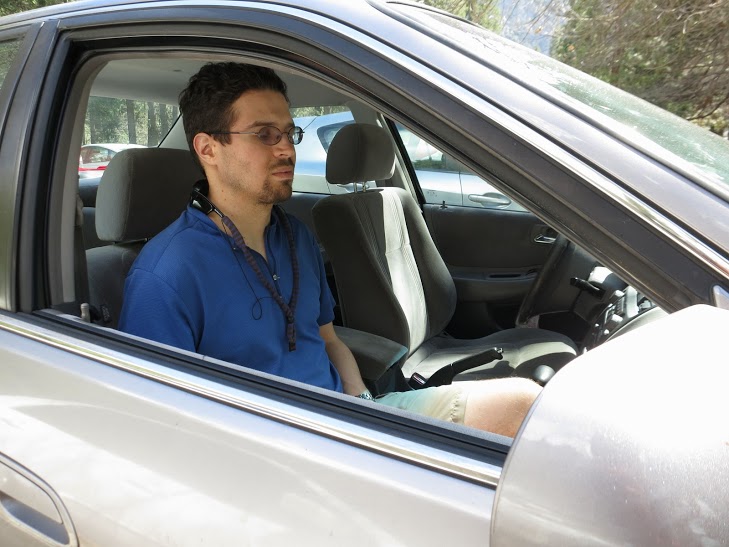
  • A parked car can be an excellent meditation room on the road. The front seats tend to be highly adjustable, and with doors shut you get decent sound protection. I bring a jacket and hat in case it's cold. :-)
  • Hotel rooms, airplanes, libraries, and churches/temples are also excellent spots.
  • If in a hotel room or friend’s home, find your meditation spot soon after arriving to eliminate last-minute stress. Even when traveling, keep your meditation spot special by using it for nothing else.
YA-Car-Meditating.jpg
YA-Hotel-Room-Meditation.JPG

Body position:

  • I travel with a jacket or sweater to roll up and put behind my lower back. With that, I can transform most any chair into an excellent meditation spot. It keeps my lower back supported while leaving my upper back free and upright, which helps me stay alert.

Noise:

  • Consider traveling with earplugs or sound-reduction earmuffs.

Timing (how to know when 30 minutes have passed):

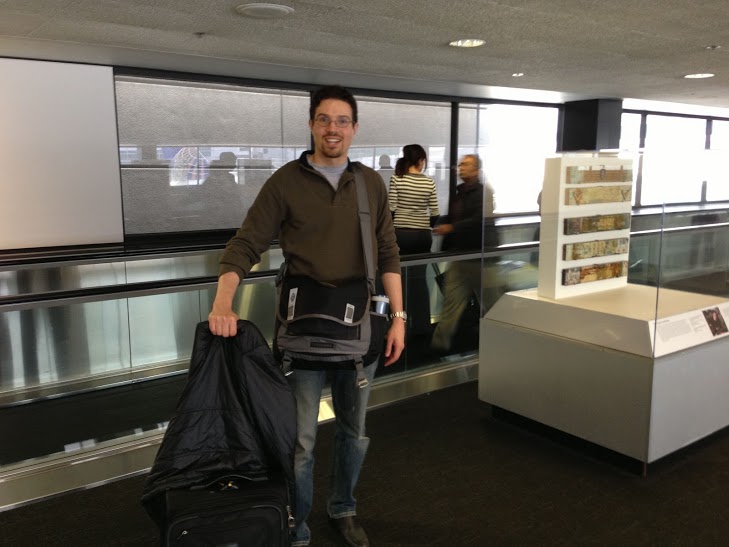
  • It's useful to get familiar with how to turn on a few features of your phone: (a) airplane mode, (b) alerts silent (e.g., "Do not disturb" mode on iPhone and "Silent Mode" on Android), and (c) vibrate timer on. That way, you can set a vibrating meditation alarm when quiet is needed or earplugs are in, and you won't be disturbed by calls or alerts.
YA-Airport.JPG

Finally, please remember that travel can also be a special opportunity. Away from the demands of our usual time and place, travel can be reconceptualized as a spiritual retreat. Flying to Los Angeles for work today, I remembered a video where Easwaran described repeating his mantram throughout an entire short flight. Inspired, I dedicated my flight to my parents and set in memorizing a new passage. What joy to discover I had my own temple in the clouds! And the Self seemed so clear in the face of each neighbor and in the mountains and even cities below.

I'm learning to be patient and proud of myself for my efforts and for wanting to meditate even under tough circumstances. I know that together, our little efforts are building a spiritual renaissance!

What are your tips for how to make meditation work when you're on the road or time is tight? Feel free to share using the comment button below – it'd be fantastic to hear from you!