Back To School: Education For Living

YA-Back-To-School.jpg

It's nearly autumn and even though most of us here at the YA Blog Team are no longer students, we're still sensing that feeling of "back to school" that accompanies the end of summer and we've been trying to figure out how to harness that feeling so we can really start the fall months off with a bang.

Since we don't need new backpacks, three-ring binders, lunchboxes, pens, or pencils, we weren't sure what "back to school" meant for us now that we're in our 20s and 30s. Then we thought of this quote from Easwaran:

Patanjali, the great teacher of meditation in ancient India, tells us to take to the spiritual life so that we may realize who we are. To me, this is real education–not education for degrees but education for living, which is a perfect description of meditation. 

Although we're not all in the midst of education for degrees, all of us YAs are in the midst of education for living – "back to school" indeed!

 So for this education, if don't need new backpacks, what do we need? We brainstormed a few ideas over here at YA Blog Headquarters, and would love to hear what you would put in the Education for Living Syllabus:

  1. "Text books" aka teachings from Easwaran – besides all of his many published books, there are lots of free web resources: the full text of the book Passage Meditationa free introductory online course, and our free quarterly journal. Also, don't forget last week's blog post with a free hour-long mp3 talk from Easwaran!
  2. "Peer reviewed studies" aka tips from other YAs – just as researchers publish results of experiments and tests they've performed, here at the blog we've gathered posts full of tips and ideas based on the experiences of other YAs. We've recently revisited Adam's post on tips for meditating while traveling, Saskia's post on meditating while in university, Abhijeet's post on how to use passages in difficult situations, and Jeremy's recent post on slowing down, and found tons of great ideas we can experiment with adding into our own daily practice.
  3. "Study buddies" aka YA community – just as it's important to read and research on your own, it can be equally important to get in touch with other students! On the blog you can join in the conversation about the passages from August or July, or even just scroll through the photos on the YA news page (and maybe submit one of your own). Also check into our online email group the YA eSatsang that provides a forum for asking questions of the group.

We'd love to hear what you think is essential material for heading back to school in education for living, feel free to share in the comments what helps you get fired up about your practice! 

And to end, we leave you with this quote from Easwaran: 

Our highest duty is to give back to life. Life is a trust, and each of us is a trustee whose job is to use the assets entrusted to us for the greatest benefit to all. It follows that the real mark of an educated man or woman is not university degrees but how much they contribute to the welfare of others, and the question to ask at graduation is not “What job will bring me the best salary or the most prestige?” but “How can I help to make the world a little better for my having lived?

EEBerkeley.jpg

 Easwaran teaching passage meditation at UC Berkeley 


Easwaran On The Katha Upanishad

[In 2013, we launched an experimental project sharing mp3 talks, which we described below. The talk referenced here is no longer available, but we'll continue sharing other mp3 talks via the blog in 2014.]

Let me start with a story – one that has been handed down for thousands of years. Its hero is a teenager in ancient India named Nachiketa, who goes to the King of Death to learn the meaning of life. The place is not essential to the narrative, but Nachiketa’s age is not incidental. Teenagers can show tremendous spiritual potential, for they have the passion, the desire, the idealism, and the reckless daring to stake everything they have on an almost impossible goal.  

– Eknath Easwaran, from Essence of the Upanishads

The story of Nachiketa has been a favorite of spiritual seekers of all ages, but since Nachiketa was a YA himself, we here at the YA Blog Team have always felt a special bond with him.

Easwaran-Talk3.jpg

In the summer of 1974, Easwaran began a series of talks on the story of Nachiketa, the story of the Katha Upanishad. His audience? Close, dedicated students most of whom were in their 20s and 30s – YAs like us. Last month the Digital Library Team at the BMCM approached us about sharing a few of these talks in mp3 format with our YA blog audience, and we jumped at the chance!

Over the coming months we’ll be presenting a few of these talks on the Katha Upanishads on the YA blog. The talks are available to stream below, or to download to your computer or mobile mp3 player.

We’re offering these hour-long talks as they were given to that close group of YA students, largely un-edited. However, this also means there are some quirks! You’ll hear pauses in the audio where Easwaran takes a drink of water or refers to his notes. The Katha Upanishad was written in Sanskrit, and Easwaran recites many phrases of the original Sanskrit text. Sometimes he’ll translate each phrase, and sometimes he won’t, but, rest assured, the gist of what’s going on is always clear.

Easwaran-Talk2.jpg
Easwaran-Talk4.jpg
Easwaran-Talk1.jpg

We are lucky that Easwaran’s teachings are being presented in a variety of ways, through books, video, and audio. Listening to this mp3 is a great experiment to see which way works best for you. If you don’t have time to listen to the hour-long talk in one go, break it up into 30, 15, 10, or even 5-minute increments.

Our main aim here is to share these wonderful talks with you, but we’re also interested in your feedback to give to the Digital Library team, who are working to build a digital library that will provide direct, worldwide access to Easwaran’s teachings. We’re still exploring what it means to build a digital library, so the more feedback you can share, the better!

We’d love to hear from you in the comments below, or by email (young.adults@easwaran.org), so please send us your answers to any or all of these questions (as an aside, if you are a YA blog reader, but not a YA, we’d still LOVE to hear from you!):

  1. Do you have any observations on the content of the talk that you’d like to share?
  2. Do you have any observations on the audio experience of the talk that you’d like to share?
  3. How might we help you interact with this content better?
  4.  Anything else?

We hope you enjoy this talk and look forward to hearing what you think. Also, before you hit “play” we thought we should warn you… Easwaran dives right into the subject of death in this talk, there is no holding back! You might be momentarily taken aback by the somber opening, but stick with it, it’s worth it!

The Art of Slowing Down

Meet Jeremy, a YA living in San Francisco. Jeremy shares some of the strategies he's developed to try and master the art of slowing down, even in the midst of a busy YA life. 

YA-Jeremy.jpg

I am sometimes a taskmaster. When it comes to time management, I realize that I am one of the best that I know. I am the reigning champion of rajas (a Sanskrit word describing high energy!).

One of the things that I realized once I started to meditate daily, however, was how being a taskmaster made my mind wander off to some next future step in a personal or work project. This even happened during meditation.

Plus, I was always doing something. Always doing something meant that I had little time. Having little time led to rushing through tasks to get everything on my growing to-do list done. Which started to lead to stress.

I decided to focus on Easwaran’s point of slowing down, and having more single-pointed focus. I wanted to get rid of some things that I didn’t need to be doing so I could focus more, for longer periods, and take my time with what I wanted to do.

What I’ve learned is that slowing down is an art.  It has also been quite a fun, challenging, and joyful experience. While I would say that I’m still mastering the art of slowing down, there are a number of practices that I’ve learned from Easwaran that can help us learn how to slow down and really enjoy everything that we’re doing – including the chores that don’t normally seem very exciting.

Learn to Red Line

I learned from Easwaran’s stories about how he began to “red-line” events and meetings in his life that were no longer of highest importance. I took that advice by beginning to make clear priorities in the things that I wanted to do more of, and things that I wanted to do less of. I don’t make New Year’s resolutions – I make “more and less” lists. I’ve done this for the last five or so years.

Correctly setting my priorities has been at the core of slowing down for me. I spend much less time doing unnecessary chores, which allows me to spend more time doing the things that I want to focus on doing more: spending time with friends and my partner, studying and teaching yoga, meditating, and focusing on being creative.

I learned to be more practical with my time, too. Being more practical with my time, especially by redlining projects that I don’t need to do, allows me to really slow down and be more focused on the things that I’ve chosen to do.

Take the Time, But Not Too Much Time

Today was a busy day. I paid monthly bills, took care of a long list of personal business, answered nearly a month’s worth of personal emails, and had my scooter repaired. I also had lunch with a friend, cooked homemade food, and am now doing laundry. Oh, and wrote this blog.

To some, a day like this would sound like madness. But the truth is, I only spend time doing my chores when I’ve taken time out to do them. One Saturday per month I do errands. It’s my Errand Saturday.

I do only errands on Errand Saturday, and I do not do errands at any other time (emergencies are the exception). And while I’m doing my errands on Errand Saturday, I’m concentrating on one errand at a time, and don’t try to multi-task (except with laundry). I do my best not to get side-tracked.

I use a similar technique when I’m at work. My job is at a high-paced, multi-billion dollar, internationally-known Silicon Valley tech company, where email continues to filter in during all hours of day and night. I’m surrounded by personalities that are sometimes under tremendous pressure, and need answers immediately, if not yesterday. To manage, I’ve learned to not pay attention to email until I’ve scheduled time to look at email, taking the largest chunks of time to do high-priority projects, and not at all sweating the small stuff. I don’t try to multi-task. I would never stop reading an important document to be temporarily distracted by email, or read an important document during a meeting where I’m supposed to be present.

These are all opportunities to be more one-pointed. We may find something interesting in the document that we’re supposed to be reading, or the meeting that we’re supposed to be attending. I think that being more one-pointed with my attention in even small tasks also helps sharpen my concentration for my next meditation.

Give Up Multi-Tasking

I also learned to give up multi-tasking. In fact, one of the greatest misconceptions is that multi-tasking is effective – it’s not very effective at all.

To prove a point, we can try an experiment with multi-tasking and time. We can multi-task through two projects at the same time, and then do the same two projects separately; one at a time.

Part One

  1. Find a computer or pen/paper. You will write two emails or letters.
  2. In your first email/letter, write or type one sentence. 
  3. Now, go to your second email and enter a sentence. It should be the same sentence as the first email. 
  4. Repeat doing this, writing a total of four sentences in each of your two letters/emails, writing one sentence in one email at a time. 

Part Two

Now, repeat this task – again writing two letters or emails. This time, however, write one letter at a time (four sentences long), timing yourself. You should use the same sentences as in your first experiment.

The first time I did this experiment, I finished part two much faster than I finished part one. Imagine now how much time we waste throughout our day, thinking that we’re being clever splitting our attention by multi-tasking through five or even more projects.

Staying Unattached to the Results

This may be the very best lesson. I really learned the art of being less attached to the results of my work, and instead just doing my best. I’ve learned from Easwaran and the Gita that being less attached to how we think things should end up really helps if things don’t end up the way we planned them. Being less attached to results allows me to enjoy everything I do.

YA-Altar.jpg

Jeremy's altar at home, filled with images and objects that are important to him.  

I’ve taken to heart that we become what we meditate on, so I choose passages that drive the point of being less attached. Two of my favorites are from the Gita:

He is dear to Me who. . . lets things come and go as they happen.  --12.17

Even as the heat of a fire turns wood to ashes, the fire of knowledge turns to ash all selfish attachment to work.  -- 4.37

So while I spend days like today getting as much done as possible, I have days like today only once a month, on Errand Saturday. And when they come, I have a great time doing each task, one at a time. My task-mastering has become about freeing up my time, and also freeing up my mind. A slow mind tends to slow down time, and a slow mind is much more one-pointed. I’m free now to spend seven other weekend days with friends, or occasionally hiking with the other YA folks in the Bay Area.

YA-Hike.jpg

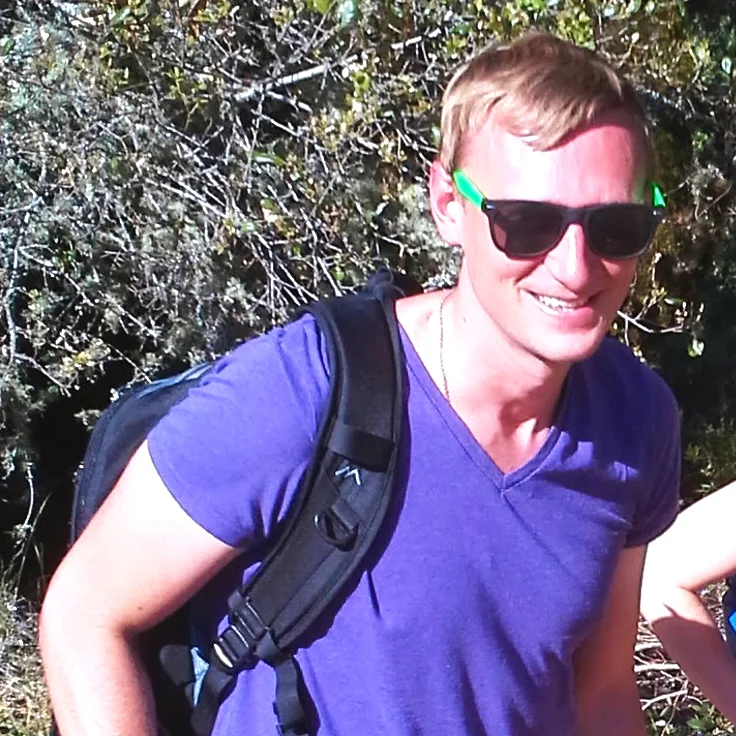
Jeremy (left) on a recent YA hike in the San Francisco area.