Working Towards an Ideal: Experiments in Vegetarianism

This week's blog post is from Logan, a YA currently living in Fort Worth, Texas. We heard from Logan before on training the senses (YA style), and this week she shares some thoughts on how she combines training the senses and putting others first to integrate vegetarianism into her lifestyle.

To give some context: Easwaran was a vegetarian, but it's not a requirement for practicing passage meditation. Logan's experiments are similar to the way many of us passage meditators look for ways to gradually work towards our own chosen ideals.

Today I'm going to talk about flexibility in my practice, in this case working towards an ideal I’m interested in: vegetarianism.

YA-Logan

I have been practicing Easwaran's eight-point program for nearly seven years. I have attended weeklong meditation retreats at the Blue Mountain Center of Meditation in Tomales, California, for the last five years, so I've spent a fair amount of time around other passage meditators.  Something you'll notice right away as a first-time retreat attendee is the delicious vegetarian meals and snacks (making the fifth point, training the senses, delightfully challenging), which, among other things, keeps me coming back year after year.
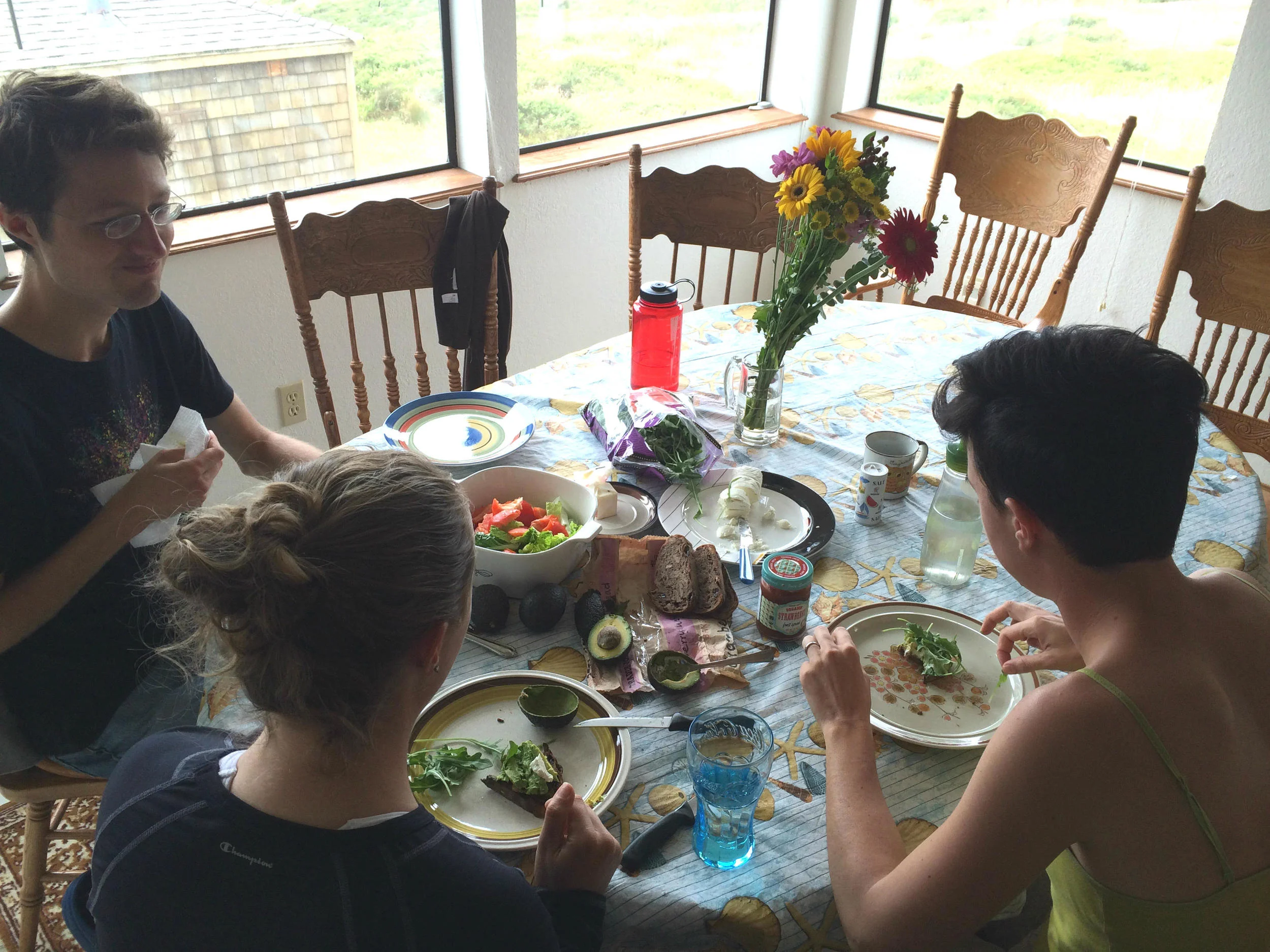
YA-Logan-Cohort

Logan (bottom right) sharing a meal with other YAs during last year's cohort program.

A topic that often comes up during retreat meal times, prompted by the wonderful meals themselves, is vegetarianism. Now, despite being brought up as a cattle rancher in west Texas, I have never been a big meat lover (much to my steak-loving father and grandfather's chagrin). Sure, I ate a diet very much like every other little Texan, but I never really craved meat or thought it sounded appealing.  When I went off to college, at a small liberal arts college in north Texas, my horizons, as they are prone to do in such circumstances, expanded. For the first time in my life I met people who identified with spiritual traditions other than Christianity– Muslims, Hindus, Buddhists and atheists became my friends. I also met my first vegetarians, two people who would become some of my best friends, and who also, coincidentally, practiced Buddhism and meditated daily.
 
After taking a couple environmental studies courses, I decided to make that my major.  The things I learned in those classes coupled with the influence of my dear vegetarian friends, prompted me to adopt a largely vegetarian diet.  This was easy at school – the cafeteria had delicious vegetarian options and a huge salad bar.  At restaurants I quickly learned to navigate menus, paring them down to their vegetarian options, which also made decision making easier.  On visits home to west Texas, an area of the world where vegetarianism largely remains an enigma to be feared or ridiculed, eating out was a bit more challenging.  I took to cooking much more often for my family and while they appreciated the "unique" and "interesting" food I prepared for them, my father always gruffly asked, half-jokingly, "where's the meat?" 
 
You may have noticed that I said I adopted a "largely vegetarian diet." I almost exclusively ate vegetarian, but I made exceptions.  If someone else was preparing a meal for me I graciously ate whatever they offered. Or if someone took me out and treated me to a meal, I gratefully accepted their meal choices. My boyfriend, Thomas, now husband, who is a fabulous cook, also adopted a largely vegetarian diet due to the influences of our friends, but he would occasionally want to cook a meat dish, and I would acquiesce to his desires.  I began to call myself a "situational vegetarian," defined by me as someone who chooses vegetarian food when possible but makes exceptions in certain situations.
 
I continued to eat this way after college when Thomas and I moved to Pittsburgh. Shortly after this move I discovered passage meditation and have been practicing ever since.  A vegetarian diet jived well with the principles of the practice and Easwaran mentions it fairly often in his talks and writings as an ideal to work towards. Thus, I was encouraged to continue my mostly meatless eating.
 
That summer, I lived and worked on an organic vegetable farm owned and operated by a staunch vegan and animal rights activist. There I experienced the opposite extreme of the eating spectrum from what I had grown up with in my cattle-ranching family. But I maintained my personal "situational vegetarian" philosophy.
 
When summer ended, Thomas and I moved to Italy where I lived and worked on a traditional farm. In that experience, I found myself in the perfect center of the meat eating vs. no meat eating spectrum. Mario, the farmer, lived like Italians had lived for centuries before – he grew almost all of his own food, bartered with neighboring farmers for goods and services he couldn't produce himself and let nothing go to waste. It was an almost entirely self-sustaining enterprise and I was full of awe and admiration for him and his lifestyle. At Mario's farm, my situational vegetarianism came to include more meat than I'd eaten in years. He was the best cook in the world (as far as my experience has yet shown) and 90% of the food on the table came from his farm, by his (and our) labor. Unlike in America where food waste is built into our eating culture, Mario wasted nothing. 
 
In the years since, my situational vegetarianism has remained my eating philosophy. At retreats it can sometimes feel as though vegetarianism is a requirement for being a passage meditator. If you aren’t vegetarian, and new to the practice, you may feel a certain embarrassment when you hear other retreat attendees at the table discussing their years of strict vegetarianism. Sometimes I struggle with this and over the years I have found myself to be a more strict vegetarian than at other times. Thomas' vegetarianism was abandoned by our senior year in college and while he respects my eating habits, he is the cook in the household and I at least respectfully and gratefully taste all his culinary creations.
 
I have made my peace with my lax vegetarianism for now. I see situational vegetarianism as a path towards a goal, a way to balance likes and dislikes and as a way to put others first (those cooking or footing the dining bill or who are uncomfortable or offended by vegetarianism). It is representative of my broader spiritual practice. Flexibility, I have learned, makes for more graceful, patient living. There are and always will be times when our lives are in upheaval and this will affect our spiritual practice. Allowing myself to adjust and tweak and change my practice accordingly is what makes it such a practical and sustainable tool for living. Giving ourselves the permission to be flexible means we do not stagnate or crumble, but progress along our path at our own pace, in our own way.
 
I greatly admire and respect those who are strict vegetarians. I like hanging out with them because I know the situation will call for vegetarian eating. Some day I will likely be one of them. But one of the most comforting things about this practice is knowing that we are all in this together, everyone does it a little differently, everyone is taking part in this grand experiment and trying different approaches, figuring out what works for them, knowing that what works for them might change, and that that's okay, too. I like crunchy peanut butter, my roommate says that smooth is better, but we both think Easwaran is really cool.
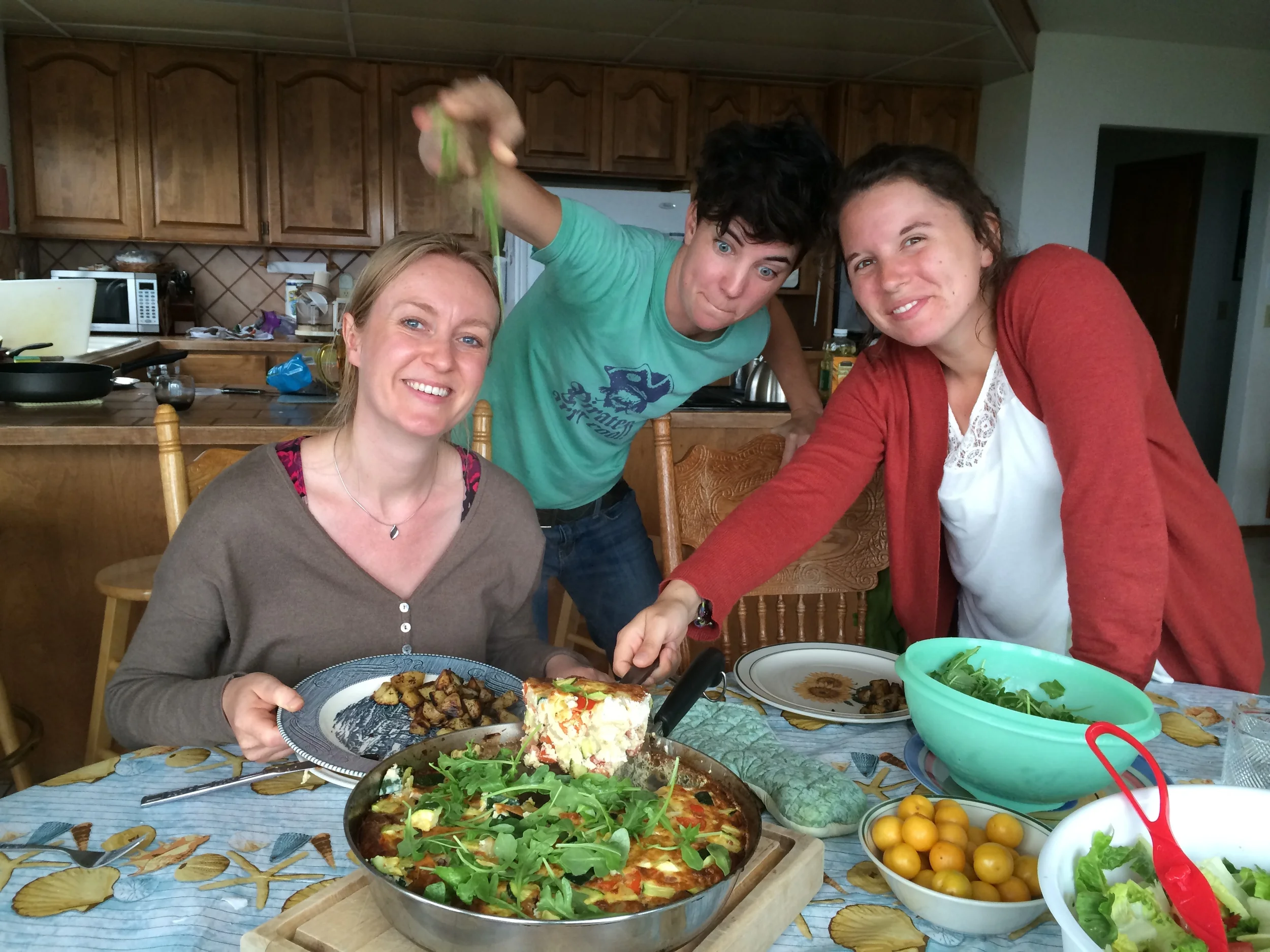
YA-Logan-Cohort

Logan (center) adding some last minute arugula to the vegetarian dinner she prepared during last summer's cohort program.

Eknath Easwaran: Meditation

We thought the new year was a good time to revisit some of the basic aspects of Easwaran’s method of meditation. We’re always amazed at how much help we get from re-reading Easwaran’s instructions on meditation, especially when it comes to the seemingly small aspects like time, or the eternal struggle of distractions. This week we’re sharing excerpts from the first chapter of Easwaran’s book Passage Meditation. If you’d like to read more, you can find the full text of the book on our website.

YA-Easwaran

I am going to suppose that your purpose in picking up this book is to learn to meditate; so I will begin straightaway with some instructions.

I recommend beginning with the Prayer of Saint Francis of Assisi. If you already know another passage, such as the Twenty-third Psalm, it will do nicely until you have learned this prayer. But over many years of teaching meditation, I have found that Saint Francis’s words have an almost universal appeal. Through them pulses the spiritual wisdom this gentle friar drew upon when he undertook the most awesome task a human being is capable of – the total transformation of character, conduct, and consciousness. 

***    

Having memorized the passage, be seated and softly close your eyes. We defeat the purpose of meditation if we look about, admiring the bird on the sill or watching people come and go. The eyes, ears, and other senses are rather like appliances with their cords plugged into the mind. During meditation, we try to pull out the plugs so we can concentrate more fully on the words of the passage. To disconnect the senses – to leave the world of sound behind, for instance – is difficult. We may even believe that it is not possible, that everything has been permanently installed. But the mystics testify that these cords can be disconnected and that when we do this, we experience a serenity beyond words.

So shut your eyes – without getting tense about it. Since the body should be relaxed, not strained, there is no need to be effortful. The best teacher for eye-closing I have seen is a baby . . . tired lids gently sliding down on tired eyes.

***    

Distractions

As you go through the passage, do not follow any association of ideas. Just keep to the words. Despite your best efforts, you will find this extremely difficult. You will begin to realize what an accomplished trickster the mind is, to what lengths it will go to evade your sovereignty.

***

Suppose that the mind does get completely away from you. What should you do? In football, as you know, certain penalties are part of the game, and in meditation too a penalty should be applied when the mind becomes unruly. Be fair, and state the rules the first day. In plain language say, “I’m sorry, but if you run away from the passage, you will have to go back to the beginning and start again.”

The mind will pale on hearing that, and for a while it will be hesitant to leave. It may stand up, look around, glance at you, perhaps meander over near the door. But you should not apply the penalty yet – the door is still closed; the mind has not gone out. As long as you are on the passage and have not forgotten about it completely, even if there is some division of attention, don’t apply the penalty; just concentrate harder.

But when the door has opened, when the mind has jumped in its sports car and sped away, when you find yourself in a dress shop or a bookstore or at the beach, act promptly. Go up and tap the mind gently on the shoulder. It will probably cringe and say, “You’re furious with me, aren’t you?”

Still another trick, the rascal! It actually wants you to become angry and start scolding, because then it won’t have to return to the passage. Don’t get impatient or rattled. Say with perfect courtesy, “This is a poor time to go browsing for a best-seller. Won’t you kindly rejoin me in the room where we’re meditating on the Prayer of Saint Francis?” And gently take the mind back to the first line: “Lord, make me . . .” If the escape occurred during the second stanza, start at the beginning of that stanza. This is hard work, and the mind will get the point.

***

So when distractions come, just ignore them. When, for instance, you are acutely aware of noises around you while meditating, concentrate harder on the words of the passage. For a while you may still hear the cars passing by, but the day will come when you hear them no longer. When I first moved to Berkeley, I lived in an ancient apartment house on a busy street. My friends said I would never be able to meditate there – “Nothing but ambulances, helicopters, and rock bands,” they told me. I sat down for meditation at twilight, and for five minutes I heard it all. After that, I might just as well have been in a remote corner of the Gobi Desert.

Time

The best time for meditation is early in the morning. In a tropical country like India, “early” has to be very early – sometimes three o’clock in traditional ashrams. But in a milder climate, I would say between five and six is a reasonable hour to begin, depending on your schedule. Starting the day early enables you to take a short walk or do some exercises, meditate, and have a leisurely breakfast with your family or friends. It sets a relaxing mood for the rest of the day.

The dawn brings freshness, renewal. Birds and other creatures know this; we, “the crown of creation,” do not seem to. I have met a few students who were very late risers indeed. I teased one of them by saying, “Have you ever seen a sunrise?” He smiled sheepishly. “Never. But a friend of mine once did.”

At first, true, there may be conflict about leaving your bed as the first rays of the sun peep in, especially when the weather is chilly. I have a simple suggestion for young people: give one mighty leap, right out of bed! Don’t think – just act. To become more alert, you might try a headstand or shoulder stand, or a few exercises. Older people, of course, can creep out of bed more slowly. But they too should be up as early as reasonable, at least by six o’clock.

I have found a great aid to rising early: settling into bed early. I am not saying sundown or eight o’clock, but ten seems to me a reasonable and healthful time to go to bed – very much the middle path, which avoids extremes.

Whenever I forgot to perform an errand for my grandmother, she would ask, “Have you ever forgotten your breakfast?” No, I had to confess, I hadn’t, nor had anybody else I knew. Strike a bargain with yourself – no meditation, no breakfast – and you won’t forget to meditate.

It helps, too, to have your meditation at the same time every morning. It will become a reflex. At five-thirty you will feel a tugging at your sleeve, a reminder to get up and begin your meditation.

***

Of course, having ample time for meditation helps free you from worrying about when to stop. Another good reason for getting up early! In this way you won’t have to cut things too closely. Twenty-nine minutes for meditation, fourteen minutes for breakfast, eight minutes to complete a project before you leave – you know the story. Give yourself plenty of time for all the essential activities.

***

Renewing Our Commitment

To make progress in meditation, you must be regular in your practice of it. Some people catch fire at the beginning, but when the novelty wears off in a few days and the hard work sets in, their fires dampen and go out. They cut back, postpone, make excuses, perhaps feel guilty and apologetic. This is precisely where our determination is tested, where we can ask ourselves, “Do I really want to get over my problems? Do I want to claim my birthright of joy, love, and peace of mind? Do I want to discover the meaning of life and of my own life?”

There is only one failure in meditation: the failure to meditate faithfully. A Hindu proverb says, “Miss one morning, and you need seven to make it up.” Or as Saint John of the Cross expressed it, “He who interrupts the course of his spiritual exercises and prayer is like a man who allows a bird to escape from his hand; he can hardly catch it again.”

Put your meditation first and everything else second; you will find, for one thing, that it enriches everything else. Even if you are on a jet or in a sickbed, don’t let that come in the way of your practice. If you are harassed by personal anxieties, it is all the more important to have your meditation; it will release the resources you need to solve the problems at hand.

To make progress in meditation, we have to be not only systematic but sincere too. It won’t do to sit and go through the mental motions halfheartedly. We need to renew our enthusiasm and commitment every day and give our best all the time. Success comes to those who keep at it – walking when they cannot run, crawling when they cannot walk, never saying “No, I can’t do this,” but always “I’ll keep trying.”

If you set out on the path of meditation – and I certainly hope that you do – please follow carefully the guidelines presented here. Read them over and over until they become thoroughly familiar to you. You may have heard the expression, “When everything else fails, follow instructions.” In meditation, you can avoid most difficulties by following the instructions from the very first. From my own experience, verified by the mystics of all lands, I know that in meditation we enter a new realm – or, more accurately, we enter with conscious eyes a realm that is already ours. To do this safely and surely we need guidance. These instructions are your guide.

You are now embarking on the most extraordinary journey, the most exacting and rewarding adventure, open to a man or woman. I haven’t tried to conceal the fact that learning to control your mind is difficult – the most difficult thing in the world. But I want to remind you always that what you are seeking is glorious beyond compare, something far beyond my capacity, or anybody’s, to render into thoughts and words. In my heart I have no greater desire than that you should reach the goal. Accept my wish for your great success!

Easwaran-Meditation

The Power of Satsang

Meet Lisa, a YA living in San Francisco. We heard from Lisa at the beginning of the blog, and this week she writes about how satsang (spiritual fellowship) has impacted both her practice and her everyday life.

Most of us have experienced moments when one isolated incident – a chance encounter, a near-fatal accident, the death of someone we love, even a tragedy read about in the morning paper – suddenly brings into sharp focus the central questions of existence. Why am I here? What happens after death? How ought I to live? We turn inwards in reflection; but if we cannot go deep into ourselves, the surface pattern of everyday living soon closes in again and the questions are forgotten. (Essence of the Upanishads by Eknath Easwaran)

I’ve always been able to take satsang a bit for granted. Growing up in a household where both my parents meditate, and my siblings – though not meditators – are fully versed in Easwaran’s teachings means I’ve always been around people who speak the same spiritual language. I’ve also always been able to attend BMCM retreats a few times a year, forging great friendships with other YAs. I’ve definitely been lucky that I’ve never felt starved for spiritual fellowship. Because of this, I think I never fully appreciated how powerful satsang could be, until this past year.

Lisa (seated on the floor – center) with the YA Cohorts at last summer's weeklong retreat, July 2014.

Last summer a friend of mine passed away suddenly. This was the first time that a close friend had passed away without warning and it was hard.

As I navigated my personal interactions surrounding my friend’s death I observed something very interesting – many of my non-meditating friends didn’t know what to do. Mutual friends of my friend who passed away were really struggling with how to “make sense” of our loss, full of anger, and increasingly overwhelmed. I found that friends of mine weren’t sure what how to comfort me, or how to express their sympathies, and many of them couldn’t bring it up. 

On the YA eSatsang (YA email fellowship group), YAs on occasion will write in requesting mantrams for a personal crisis, or an ill family member. I wrote in and asked for mantrams for my friend. I found so much comfort from the emails that came in reply, many from YAs I’d never met. I was amazed at how much they helped! My email request led to emails, texts, and chats from YA friends I’ve made over the years all of whom were quick to lend their support.

YA-Mantram-Art

Mantram art sent to Lisa from a YA friend.

Easwaran writes often about death – and he’s always incredibly direct. But he writes this way for a reason! I’ve found in myself, and observed in others, that (even if we’re not trying) this practice gives us tools we can use to deal with death, a time that can be scary and full of uncertainty. Having a mantram gives my mind something to hang onto when I’m agitated, and an easy way to say a prayer for someone else.  Putting others first means that even when I feel awkward or unsure, I’ll try and find a way to reach out to someone who might need it. And, of course, there’s always meditation.

Over a retreat last summer I memorized the passage “What is Real Never Ceases” from the Bhagavad Gita. When I learned the news of my friend’s death they leapt to my mind:

The Self dwells in the house of the body, which passes through childhood, youth, and old age.  So passes the Self at the time of death into another body. The wise know this truth and are not deceived by it. 

***

What is real never ceases to be. The unreal never is. The sages who realize the Self know the secret of what is and what is not. 

Know that the Self, the ground of existence, can never be destroyed or diminished. For the changeless cannot be changed. 

This passage continues to be a great comfort to me.

Easwaran’s message about death, and it’s place in our everyday life, is often so opposite to what we see in our everyday media: 

Death should never be faceless; death is always personal. Whether it is someone in our home, or a child on the other side of the globe, or even one of God’s creatures like the elephant or the fox, all of us love life; all of us fear death. This is the unity that binds us all together, and as our eyes begin to open to it, we shall see life’s transiency everywhere we go. (The Undiscovered County by Eknath Easwaran)

This practice gives us powerful tools to deal with death when it touches our personal lives, but also to lend support to others around us.

I thank the many people who supported me, and encourage all of us to reach out wherever we can to help others.