Practicing Passage Meditation Within A Faith Tradition

Meet Carlos, a YA in the San Francisco Bay Area. As a practicing Catholic, Carlos shares how passage meditation complements and supports his faith, and enables him to move closer to his parents who have a different perspective about practicing their religion.

Carlos.jpg

My name is Carlos and I live in Concord, California, near San Francisco. I practice passage meditation and I also happen to go to church. I was baptized and confirmed into the Catholic faith. My parents raised my brothers and me on Bible stories, rosary prayers, and weekly attendance at mass. Upon graduating from college, I still found myself clinging to the Lord for security, direction, and guidance. At the same time, my brother introduced me to Eknath Easwaran and his method of passage meditation. At first I was merely drawn to Easwaran’s voice and his presence. In time, I started meditating. Meditation deepened my faith by helping me to live it in daily life.

Every day for me now begins with meditation first thing in the morning. I meditate for 30 minutes on an inspirational passage. Often I meditate on the Prayer of Saint Francis of Assisi, or another passage from the Christian tradition. The passages Easwaran recommends for meditation can be found in his book God Makes the Rivers to Flow and online here.

I remind myself of the ideals I have meditated on in the morning by practicing “repetition of the mantram” throughout the day. This discipline is one of the points in Easwaran’s eight-point program of passage meditation (you can see an explanation of the eight points here.) The mantram I chose is the name of Jesus. I repeat His holy name, silently in my mind, whenever I have a spare moment, whenever I can remember.  When I repeat the mantram, I call on Jesus continually. It helps me clear my mind of worry, and rely more and more on Jesus’ strength in any circumstance. I can bear with difficult times and get through them by repeating the mantram. 

In practice, when do I start repeating the mantram? It may be when I have just have turned off the light at night. I may have just woken up in the morning. I may be sitting in the bathroom. I may be walking or jogging. I may be in my car, taking a moment to pause before turning on the ignition. I may be waiting at a stoplight, waiting in line at the grocery, walking through a hallway, or walking past someone. When I get to work, I may have just seen the sticky on my computer monitor with “M” written on it. The more I practice repeating the mantram, the easier it becomes. However, I try not to repeat my mantram whenever I’m doing something that requires my full concentration (such as while driving or cutting apples).

Easwaran had already passed away by the time I first "met" him, so I heard him through a recorded audio talk. I now meet him daily through his recorded teachings, such as in his audio commentary on The Imitation of Christ by Thomas à Kempis. I may listen to these before sleeping at night, or when I find a spare (or planned) moment during the day to hear his calming words.  I meet Easwaran as well when I observe his manner and his attitude when he teaches from his videotaped talks. I also feel that I meet him when I practice daily the point “spiritual reading.” I happen to read short segments at a time, from any of his books on meditation, which I’ve collected over time. I also read passages and gain inspiration from the works of such figures as Mother Teresa and Thérèse of Lisieux.

Carlos-Meditation-Corner.JPG

Here we see Carlos' meditation corner along with his books for spiritual reading and a stereo for listening to Easwaran's audio commentary. 

One point which I’ve shied away from when I started my practice was “spiritual fellowship.” At first I was reluctant to meet with other passage meditators. However, gradually Easwaran has now become more alive for me, not only through his recorded teachings, but through the dedication of friends who also practice passage meditation.  We meet regularly for spiritual fellowship (called “satsang” in Sanskrit). Satsang can take the form of in-person gatherings or even through virtual meetings in the BMCM’s online Young Adult eSatsang, where I can read messages from fellow young adult meditators around the globe, who share their questions, struggles, and triumphs in meditation. In fellowship, or satsang, we support each other in our practice as we get together to read his books, watch his videos, and meditate on inspirational passages. We can also share a meal, go on a hike, enjoy a beach walk, or participate in any recreation which benefits our practice. We can also attend retreats offered by the Blue Mountain Center of Meditation, the organization which Easwaran founded. At these retreats, I join with experienced meditators in finding renewed focus and fervor in bringing our strengthened practice back home.

Carlos-YA-Hike.jpg
Carlos-YA-Outing.jpg

Though initially reluctant to meet with other passage meditators, Carlos is now an active member of the YA community. At a recent YA outing in the San Francisco Bay Area Carlos enjoyed the trails and some impromptu frisbee!

Meditation has helped me with a particular challenge I’ve had since taking it up: relating my practice to my parents, who are in the Catholic faith, and do not practice passage meditation. I had a small success in using the eight points during a lunch with them this past Easter. It was Easter Sunday, and I had just attended the Easter service – without my parents. They had already gone to an earlier Easter service, and we  planned on having lunch together when I was done. This is the beauty of living a life trying to practice meditation and the allied disciplines. Life is not perfect, but you try to make it as perfect as you can. This Easter, then, took on a whole new significance. For me, it is like participating in Jesus’ life after death; even life amidst death. Even though there may be a kind of “death,” or a tension, between my parents and me, we try to be together on those fronts in which we can be together. For me, “life” here meant finding the time to be together regardless of our differences on how we live our faith. Being together with them on Easter was my first small success.

My second small success, most visibly, was that we all came to a sense of relief. For my parents, my mom in particular, it was the relief that I was not going astray on a wrong, misguided path. For me, it was the relief of experiencing my parents’ relief. Less visibly, I was happy (with the help daily meditation has given me) to be able to look past my anger and my thoughts of confusion – and focus instead on understanding my parents’ point of view, and on finding words to use which we could both understand and share.

During the lunch, my mom recalled reading one of the Blue Mountain quarterly journals. She expressed disagreement with something Easwaran said about God in one of the articles. She was concerned that it was taking me off the path of my faith upbringing. I could have brooded the distraction in my mind, “did he say that?” However I chose to use the point, “one-pointed attention,” to focus just on what my mom was trying to tell me, which was very difficult when my own thoughts were clamoring to be expressed. For at least a few moments, one-pointed attention kept me as clear as possible on what she was trying to say, and prevented me from interrupting her while she spoke.

Yet when she did pause, my one-pointed attention really needed some help. The help came in the form of practicing the point “slowing down.” Though my mind needed to slow down to start giving some one-pointed attention in the first place, my mind needed to slow down even further to allow for time and patience to see what she needed this breathing room for. Make no mistake, slowing down did not mean laying back and slouching.

It meant using the freed-up time for practicing the point “putting others first.” To begin with, I tried to put her first by speaking my thoughts. However, I quickly realized that it wasn’t my thoughts she needed to hear just then. Instead, she needed to see that I understood, or at least was trying to understand her views. We both needed time! I needed the time to put her first by placing myself in her shoes as best I could. She needed time to see that I was listening, trying my best to understand her, and giving her my respect.

I also used the point “training the senses” in this situation.  On one hand, I practiced the training of my palate by choosing the kind and quantity of food that was healthy and sensible for my body. On the other hand, I was training my mind to choose healthy thoughts, thoughts that would vitalize my mind instead of wearing it down. In slowing down and in putting my parents first, thoughts of love, respect, and patience came into view, and thoughts of anger or impatience subsided.

Carlos-Brother.jpg

Carlos (right) and his brother, who introduced him to passage meditation, at Half Dome in Yosemite National Park. 

Remarkably, the love, respect, and patience I was able to foster helped me see the love, respect, and patience my parents were already trying to give me. I joined together with them in spiritual fellowship at heart, as I appreciated their efforts to love as just like my own.

Eventually, the conversation boiled down to a difference in opinions, or a difference in expressing the same opinion. It was really difficult to separate myself from my views and my ways of expressing things about my meditation teacher, Easwaran. However, the effort to try to understand my parents as best I could, and to refrain from speaking when I knew it wouldn’t make things better, has really paid off. I can now sit down with them and have a meal without being overly defensive (or at least not as defensive as in the past). My parents can share their views about God, and recommend ways for me to stay true to my faith tradition, without me getting as flustered as I have before. It can be a real challenge, but it’s a chance to deepen my faith and reliance on Jesus’ strength, deepen my meditation, and deepen my relationship with Easwaran as my teacher.


Meditation In Life's Transitions: From YA To Parent

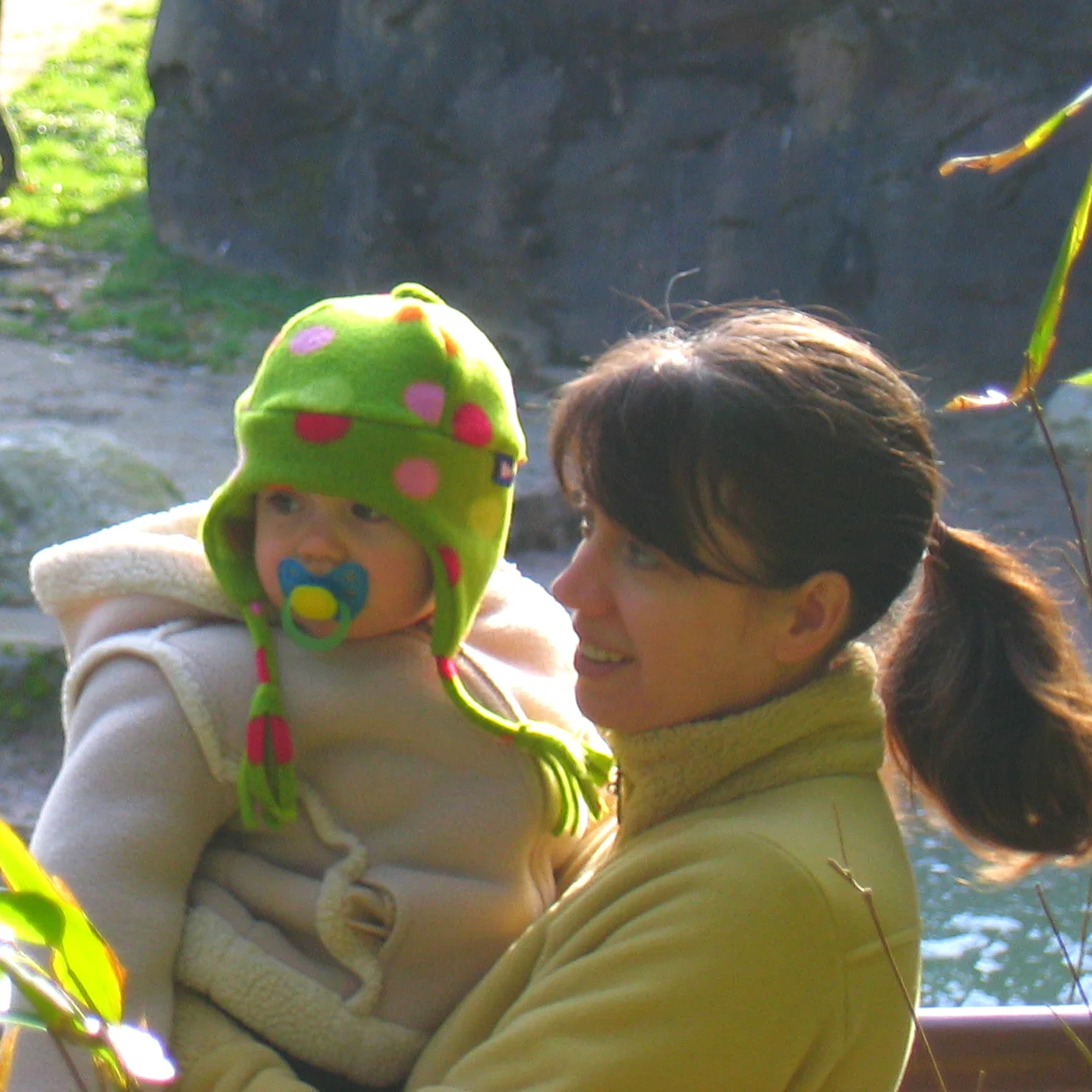
Meet Nancy, a passage meditator living in Seattle, Washington. Nancy shares the story of beginning her practice, participating in the young adult program and then transitioning into a post-YA life focused on infusing her family life with her spiritual ideals.

Nancy.jpg

The first time I encountered Easwaran and his program of meditation was in 1986, when I was a junior at my university. I was trying to figure out what I should do with my life when I graduated. I wanted to do something that would be of service to people, to the world, but I didn't know what it was.

During my summer break I became fascinated with the Religion section in the Undergrad library, reading about aboriginal spirituality, Hinduism, Zen Buddhism, and Christian mysticism. All of this reading, and thinking hard about what I was reading, led me to think I should start meditating, but I had no idea of where to go to learn.

I didn't want to join any particular group or change my religion. I hoped I might be able to find a book on it, so I looked in the B. Dalton bookstore near the campus. I picked up a book titled Meditation, which had a picture of man who looked very kind. I started reading the introduction. In one short chapter the author introduced and led me through the eight points and three profound concepts in the simplest way: "You are not your mind, you are not your body, you are divine." 

"Having discovered that we are not the body, not the mind – both subject to change, to growth and decline – the question remains, “Who am I?” In the third stage, the tremendous climax of meditation, we make the most significant discovery any human being can ever make: we find out who we really are." - Eknath Easwaran


Meditation-Book.jpg
Meditation-Page.jpg

Nancy's original book Meditation (now titled Passage Meditation), which she found in college. Nancy spent many years reading Easwaran's books, which gave her a strong foundation to eventually start her own daily meditation practice.

I was enthralled, and hooked. I was certain I wanted to learn to meditate. Except it took me another 10 years to get there. I started reading the daily thought from Words to Live By each day before I started work, repeating my mantram, and trying to slow down. I kept reading Easwaran's books, Meditation (again), Take Your Time, The Bhagavad Gita, Conquest of Mind, Dialogue with Death, and Climbing the Blue Mountain. Before I knew it, 9 years had passed and I was turning 30.

I was worried about all sorts of world issues big, giant problems that I had no clue about how to solve. I read Climbing the Blue Mountain again and the message I got from it was, "Don't wait another day! Start now!" and that I should change myself first, that the resources I needed would come from that. So I finally started.

I began meditating every day. In 1996 I attended a one-day regional retreat and started attending a local satsang (fellowship group). A woman in our satsang encouraged me to attend a retreat in Tomales because there was a chance I could see Easwaran and hear him speak. So in June of 1997, I went to a weeklong retreat. We stayed and met in Dillon Beach because the retreat house was not finished yet. It was a wonderful retreat and the first time I saw how I could be practicing all eight points throughout the day. It was also wonderful because I saw how Easwaran absolutely lived and embodied everything he was teaching about. He clearly was an authentic spiritual teacher, and his students were sincerely living the program he was teaching.

Nancy-Easwaran-Retreat.jpg

Nancy (circled here) met Easwaran in 1997 at her first weeklong retreat -- a life-changing experience. 

I eagerly embraced my practice and continued to attend retreats. Then around 2001 something resembling a YA program and eSatsang popped up. I felt a wonderful kinship with the people who were writing in... we all shared this burning desire to grow in our practice, to apply the eight points in our daily life, to figure out what we were doing in our life choices and how we could make these choices in a spiritual way, and to find ways to help our world.

I attended a couple of YA retreats during the summers of 2001 and 2002. They were full of spiritual study, selfless work, meditation, wonderful satsang, and "right" entertainment. The time I spent in these retreats was so motivating and so inspiring. I will always carry them with me in my heart. We were all trying to figure out what our svadharma (personal dharma, life purpose) was...that was a huge topic.

I started to think of my spiritual practice as my real job, and started looking for ways to infuse my practice into all of the other things I did in lifemy work, my relationships, everything I did during the day.

Throughout this entire process of discovery (starting in 1988), I was with my boyfriend, then partner, now husband. The entire time I was trying to figure out how to blend my practice into my daily life, and into my life with him. He does not practice this method of meditation, nor has he ever shown any interest in doing so. But he has always supported me in my practice.

Something I was struggling with throughout all of this time was when we would get married, and would we try to have children. I was scared of both. And I was worried about how I would keep my practice going if we had children. My practice helped me to be able to face these questions head on and finally make a choice and commit.

We got married in 2003 and our daughter was born in 2005. And my practice now is not the same as it was before I had a child. But it's still good and growing. One of the changes that has occurred is I'm learning how to consciously live in unity as a family. I feel like I'm taking a lot of higher-level courses on selfless service: "How to become more and more selfless," which is a wonderful antidote to my self-centeredness.

Husband-Daughter.jpg
Nancy-Daughter.jpg
Nancy-Daughter-2.jpg

The YA programs helped Nancy figure out her own svadharma (path). Deciding to marry her long-term partner and start a family, Nancy is now sharing her high ideals and spiritual tools with her husband and daughter. 

I stopped participating in the YA eSatsang a few years ago, partially because I thought I was too old, but mostly because I finally felt settled about the direction I've chosen in life, and what my svadharma is. For satsang, I've transitioned from the YA group to the family program. And I continue to participate in our local satsang group.

Participating in the family program has been a wonderful resource for learning ways to infuse our daily life with the spiritual ideals that Easwaran taught and lived. The BMCM family program offers an online class that families across the globe can participate in. We share our experiences of weaving the eight-point program into family life, and learn about resources that we can use to do this. We've also gotten together with other families to share satsang together, and we've even performed skits and plays about St. Francis and St. Clare, and Sri Krishna.

Nancy-Family.jpg
Nancy-Family-Program.JPG

In this new stage of life focused on her family, Nancy has found helpful resources in the BMCM's family programs. Gathering with other passage meditator families, Nancy and her daughter dressed up to put on a play about the life of Sri Krishna.

I keep working on finding ways to include my family in my spiritual practice, but not in a forced way. My biggest desire for my daughter is that she discovers the joy I first discovered, and keep rediscovering in following this spiritual path. She is 7 years old now. She has her own mantram book, and a puja (altar) "shelf" in her bedroom. We have written the mantram together when we were worried about a loved one who was sick, or when she was upset with one of her friends. We sing mantram songs. We attend church together as a family, and my daughter also attends the parish school.

Nancy-Puja-Shelf.jpg

The puja shelf (altar) belonging to Nancy's daughter showing holy pictures and statues from many faith traditions. 

I am finding that our parish affiliation, my daughter's school, the BMCM family program, and my eight-point practice are all providing different angles from which I can find ways to share high spiritual ideals and tools with my husband and daughter.

What I'm learning through family life is, it's all yoga. Everything in my life is part of my spiritual practice. My spiritual practice isn't confined to the period of time I spend meditating, or the bits of time I remember to repeat my mantram throughout the day, or the piece of chocolate I did or didn't eat. It now includes getting up multiple times during the night and not being grumpy about it when my daughter is sick or our elderly dog needs to go out. It means planning healthy meals that we can sit down and enjoy together, and not cramming too many activities into our day so we have time to enjoy each other’s company.

Nancy-Family.jpg

It's a mode of operation throughout the day, a constant striving to find ways to live in harmony with my environment and people around me. I'm learning that it's a way of being that includes learning from my mistakes, and then trying to make the better choice at every next opportunity.

"When we come into life, we come as servants of the Lord. Nobody is unemployed. When we live our lives selflessly, helping in every possible way, which the earth needs from everyone, we are living in the Lord." – Eknath Easwaran


Applying Passages To Difficult Situations

Could a passage help a difficult work relationship? Abhijeet, a YA living in Tomales, California, answers "Yes!" and shares some of his strategies in this post. 

Abhijeet.jpg

One of Easwaran’s aphorisms that has always intrigued me is “obstacles are opportunities for growth.” I would like to share how inspirational passages helped me in a work-related situation. In my previous job, I was a part of an amazing team of engineers. All of us came from different cultural backgrounds, and although we enjoyed each other's company, as Easwaran would say, there were many opportunities for “rubbing off each other’s angles and corners.” In one such project, I was working closely with a guy who was not easy to get along with. Our style of communication was quite different and I felt that there was always a palpable tension between us. Understandably, this did not make work fun and I felt very challenged and resentful. One of Easwaran’s aphorisms that struck a chord with me was “You and I are on one side and the problem is on the other side." However, I did not have a clue about how I could practically implement this aphorism or try it out in daily life.

The answer came in the form of meditation on an inspirational passage. I had heard Easwaran describe an amazing example of how the inspirational passage can be used as a peg to drive out negative and deeply conditioned thought patterns. The neat thing about inspirational passages is that they enabled me to substitute those negative thoughts and emotions with much higher and positive ones. I had something to hold on to when my mind was spewing negative thoughts at an alarming rate. I learnt that I had no control on the external events but as Easwaran says, I could train my mind to respond calmly rather than reacting to the events that unfolded.

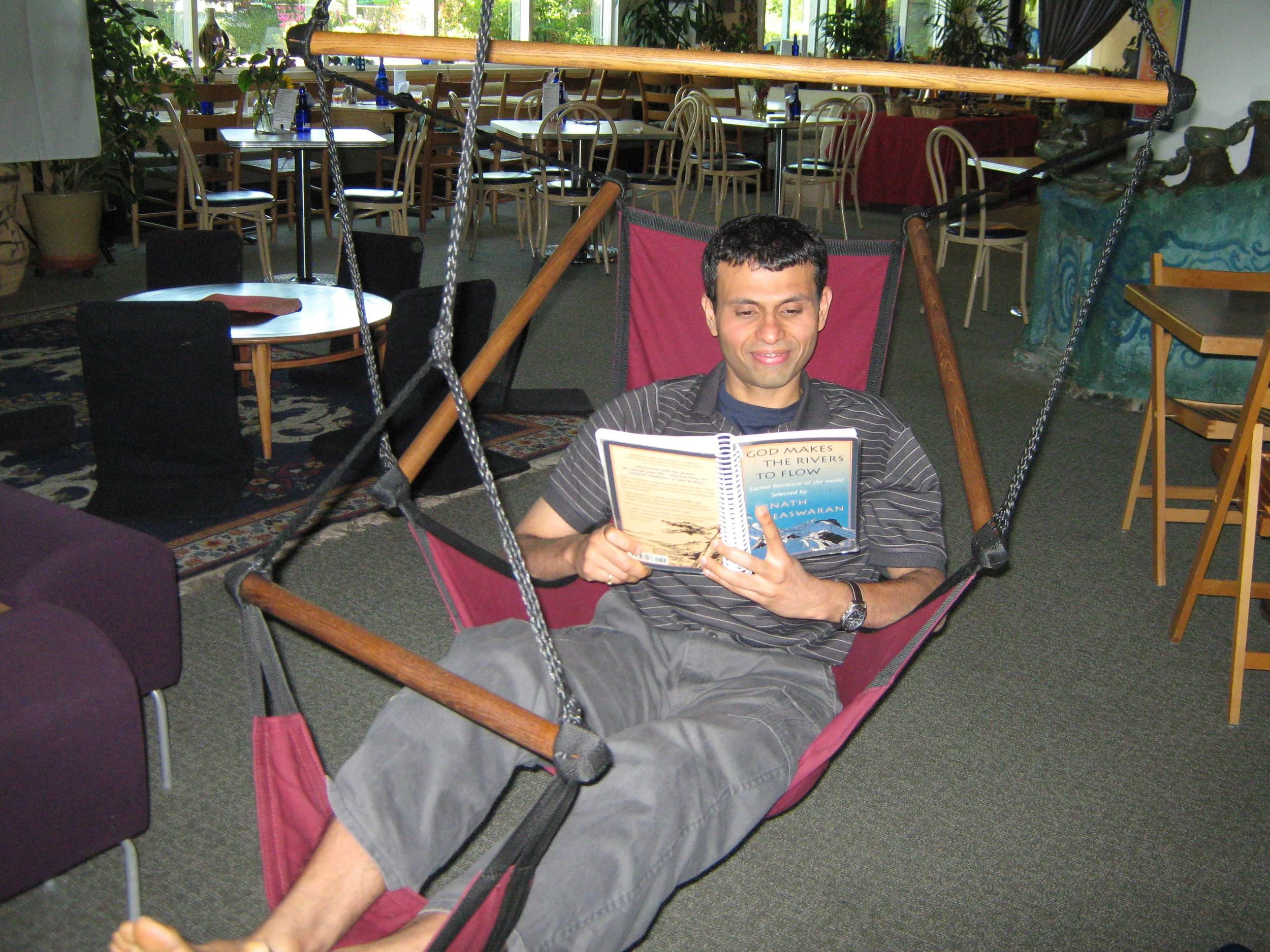
I browsed through God Makes the Rivers to Flow, which is an anthology of inspirational passages ideal for meditation. It was like seeking a wise counselor or friend who had the answer to my challenging situation. Towards the end of God Makes the Rivers to Flow is a section titled ‘Using Inspirational Passages to Change Negative Thinking.’ After going through that section, I short-listed a few passages that appealed to me – Discourse on Good Will, Evening Prayer for the Sabbath, and Whatever You Do.

Abhijeet-YA.JPG
Abhijeet2.JPG

These passages reminded me of the qualities I wanted to cultivate in dealing with my situation at work. I started to memorize them, and used them one by one in my morning meditation.

A couple of those passages were available in the mp3 format from the Easwaran.org website so I downloaded them on my iPod and listened to them on the bus to work.

Abhijeet-Desk.jpg

Before starting my work day, I would take 10 minutes to write a part the passage as a way to commit it to memory. The words of the passage would remind me to look for positive qualities in my colleague and myself. When I would get upset during the day because of an interaction with him, I would come back to my desk and read the passages I had posted next to my computer screen.

I wrote stanzas from those passages on flash cards so that I could continue memorizing them and also read them when I needed inspiration, support, guidance and wise counsel.

I remember one challenging day when nothing seemed to be going well and I was truly disappointed. A thought of taking my colleague out to an Indian restaurant and ordering super spicy food for him crossed my mind! Part of it was coming from trying to inject humor in the situation, and part of it was coming from trying to get even. However, these words from the passage came to my rescue – “Let no one deceive another, let no one anywhere despise another, let no one out of anger or resentment wish suffering on anyone at all.”

The passages taught me that the best way to get even was to actually try to get to know my colleague a little better. Every day, I started making an attempt to converse with him about something other than work. I noticed that he had pictures of his family in his office, so I started asking him about them. For a long time, I felt that nothing was changing. When I returned home, I used to sit on my meditation cushion and meditate on the “Evening Prayer for the Sabbath” for my evening meditation. Here is an excerpt from this passage that gave me a lot of solace –

“I must do my allotted task with unflagging faithfulness even though the eye of no task master is on me. I must be gentle in the face of ingratitude or when slander distorts my noblest motives. I must come to the end of each day with a feeling that I have used its gifts gratefully and faced its trials bravely.”

I would list out the positives from the day on a sheet of paper and place them on my altar.

Abhijeet-Meditation.JPG
Abhijeet-altar.JPG

Gradually, over a period of time, things started shifting a little. I learnt that he was a good family man who loved his wife and children. He also liked American football. Although I knew nothing about this sport, I started asking him more about the rules, the games during the football season, and his favorite players. It was quite refreshing as I realized that amidst all the challenges and our differences, there was some human connection. I also started enjoying listening to how he spent his time with his family on the weekends.

We worked on the project together for more than 6 months and I confess that our differences did not completely disappear. Yet the passages helped me see many positives in my colleague, myself, and our project too. Our working relationship improved over the course of those six months. I was truly amazed by the power of the passages and the benefits of meditating on passages. In the past, I would have fallen sick under the stress and lost hope. However, this time I somehow managed to conduct myself rather well under the circumstances. When I would get agitated before, during and after meetings, I used the passage, Whatever you do – “Whatever you do, make it an offering to me, the food you eat, the worship you perform, the help you give, even your suffering.”  Thanks to the powerful words of the inspirational passages and the eight-point program, I got a lot of comfort and support when I needed it.

Most of all, the passages became my buddies and I felt that I could hang out with them whenever I needed to. 

Abhijeet-Buddies.JPG