YA Book Recommendations

While helping out at a BMCM event this past Saturday, one YA asked for book recommendations.

While helping out at a BMCM event this past Saturday, one YA asked for book recommendations.

This past weekend, members of the YA Blog Team were able to hang out with YAs from all over North America. While we were together, a friend asked "What Easwaran book is your favorite, and what book would you recommend to a YA?" What a GREAT question! Our conversation on Saturday was brief, and we thought this was the perfect question to bring to the wider YA community.

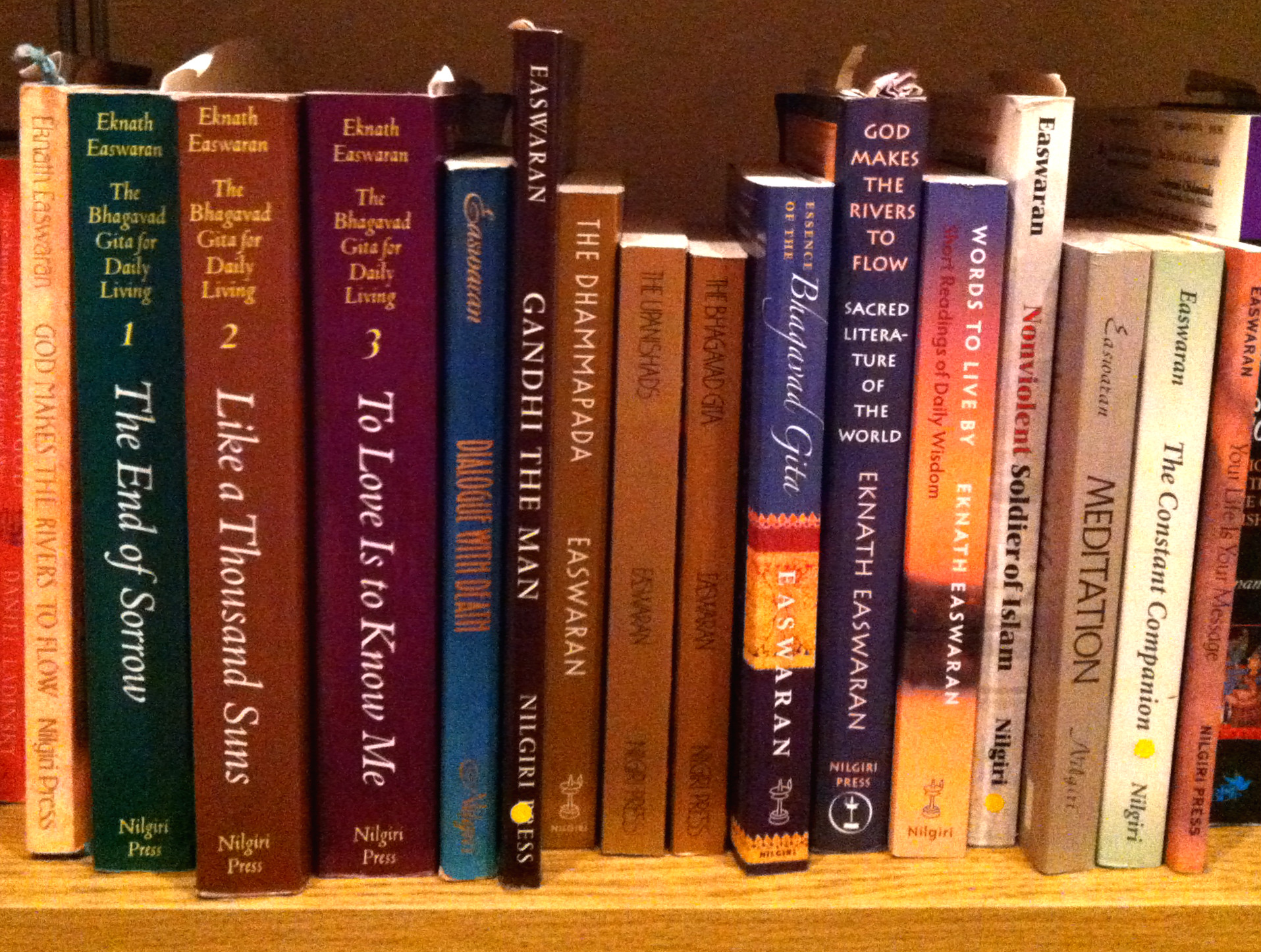
One of the first answers to come up over the weekend was Essence of the Upanishads  (formerly Dialogue with Death).  We even have proof on the blog in Gary's post and Lisa's post both of whom mention being struck by Easwaran's writings on "training the will." This book is based on talks Easwaran gave to YAs in the 1970s on the Katha Upanishad, and we think it's just perfect for YAs.

The other book that was immediately nominated (outside of Passage Meditation, of course) was Conquest of Mind . Our consensus on Saturday was that Conquest of Mind is a great choice because it neatly lays out how the practice of passage meditation and the eight points can positively impact your day-to-day life in ways small and large!
IMG_2339 - pixlr.jpg

Well, thank goodness for this question because it reminded us about a special deal the BMCM has on these books. The "Shaping Your Life Collection" is a special deal offering Essence of the Upanishads, Conquest of Mind, and Gandhi the Man all for less than $40. Plus, the special includes a free mp3 talk by Easwaran on the life of Gandhi. (Of course, Gandhi is an obvious choice for YA audiences. We've already seen how Gandhi impacted Jan and Easwaran!)

We'd love to hear your book recommendations in the comments below. Please share your answers to either or both of these questions: 

  1. What is your favorite Easwaran book and why?
  2. What book would you recommend specifically to a YA and why? 

Even if your answers are the same as what we thought of, share your thoughts on why – we'd love to hear from you! 

Training the Senses – YA Style

Meet Logan, a YA living in Fort Worth, Texas. Logan shares some tips and stories about a day-to-day issue in YA life – training the senses.

YA-Logan.jpg

I’ve been practicing Eknath Easwaran’s eight-point program of passage meditation for five years now, and I must say, while I’m lifetimes away from perfect, I do feel that I’m lucky to be a bit “ahead of the game” when it comes to the fifth point, training the senses.  

When I say that I’m ahead of the game, I mean that I have no moderate to serious addictions to anything, no debilitating dependences on drugs, alcohol, television, internet, or ice cream.  I’m pretty health-conscious.  Some credit should go to my parents for my good upbringing (nurture), and some to my genetics (nature) but probably most to karma/God/fortune/however you want to word it.  But just because I’m a little ahead of the game, doesn’t mean I’m not in the game.  And what a challenging game it is!

Training the senses may well be the most “disliked” of all the eight points.  I mean, who wants to face their unhealthy desires in combat, let alone acknowledge they exist?  It can be embarrassing, disheartening, maddening, frustrating, and annoying.  Fortunately, passage meditation is not a practice of asceticism or complete renunciation, but a “come as you are” party, as Easwaran liked to say.  It gives us the tools to gradually achieve our highest ideals, no matter where we begin in our lives.  So, instead of getting totally upset about the mistakes we make and giving up on change, the eight-point program allows us to take baby steps, acknowledging our shortcomings, then learning from them, working with them, and being creative to overcome them.  Sometimes we fall back a few steps, but that should not dishearten us either, only remind us to be patient with ourselves.

I’ve heard some anecdotes from long-time passage meditators saying that after beginning their practice, certain unhealthy habits and desires (such as cigarette smoking) just sort of faded away, almost without their realizing it.  To put it one way, through a dedicated practice of passage meditation, our unhealthy desires are transformed into healthy desires.  The problem is not necessarily the action itself, but the desire to do the action. As it says in the Brihadaranyaka Upanishad, “You are what your deep, driving desire is.  As your desire is, so is your will. As your will is, so is your deed. As your deed is, so is your destiny.”

Now, to perhaps be more practical, more real world, here are some personal anecdotes.  

Say it’s Thanksgiving.  It is a well-known fact that holidays lead to overeating.  You don’t want to overeat.  You know what’s going to happen if you do: stomach pain, indigestion, fatigue, more frequent trips to the restroom; no one desires these things.  But you do desire to have more and more of that delicious food in your mouth.  What is one to do?  I try to catch myself in the midst of this desire, to interrupt my stream of thought (it doesn’t always work, but we keep on trying!) and insert some mantrams right in between them, create a traffic jam, as it were, employ point number three, and slow down.  If possible, I remove the temptation (“lead us not into temptation…”), move away from the dinner table, perhaps join my uncle in the living room where he is watching football (I have no interest in football, so I’m not in danger of over indulging myself in the living room), or better yet, go for a walk with some cousins.  If the temptation is removed or avoided long enough, often the desire fades away.

meditation corner.JPG

Logan's meditation corner, complete with dog tail (lower left corner)! 

Now, say you’re in college.  Or that you’re married to someone whose job requires that you attend many social gatherings, most frequently, cocktail parties.  In both cases, alcohol makes quite a few appearances.  I was never much of a drinker myself, opting to go to bed early rather than attending the typical college party, so the temptation, the desire, in this case, was for the most part, not a big issue.  If it were to be present, the same actions described above relating to overeating would apply.  However, say you feel compelled to drink, socially, to fit in, to make those around you more comfortable (or occasionally, just for the heck of it).  This is often the case for me at the aforementioned social gatherings – cocktail parties.  At such times, it is in a way my “duty” to impress people, to entertain them, to be amusing, charming, etc. and, of course, to make them feel comfortable by following the norm.  The norm is to drink alcohol, mostly vodka around here for some reason.  Luckily, vodka is clear!  Guess what else is clear?  Water!  I often fake a cocktail, requesting a sparkling water in a cocktail glass (sometimes I do have one, but that’s usually quite enough for me).  In the context of college (or some situation where beer is more prevalent), I have been known to drink one beer (out of a brown bottle) and fill it back up with water after that.  

I know, I know, this may seem deceitful, but in some cases explaining my spiritual decisions is impractical.  There is a time and place, but, unfortunately, that time and place is usually not in Texas at a fancy opera cocktail party or at a loud college frat house, whatever the case may be.  And of course, if it does come up, you can combine training the senses with putting others first– you can always be the designated driver!

And then there’s drugs.  Drugs may be desirable for a variety of reasons, more reasons than there are drugs.  College campuses are one place that many drugs may be found, but their allure is certainly not limited to students.  Some people use them to escape from some negative emotion or situation; however, this type of escape is quite temporary and when reality has returned the problem is still present.  Others use them for purely recreational purposes, but this may lead to a dependence on drugs to have fun, or at the very least cause unnecessary agitation of the mind, whether positive or negative, making meditation and one-pointed attention more difficult.  Still others, the curious type, just want to find out what they’re like.  Or maybe they are even spiritually curious, wondering what delving into the subconscious is like, as in the case of psychedelic drugs.  This same curiosity, however, may also prompt them to try meditation, a much safer, more stable way to break through the surface of consciousness.   

Whatever the case, whatever combination of desires lead to doing drugs, another desire can gradually begin to trump them.  As in the Bhagavad Gita, “Though aspirants abstain from sense pleasures, they will still crave for them.  These cravings will all disappear when they see the Lord of Love.”  From my own experience, as I have continued to practice passage meditation over the past five years, my desire to go deeper in meditation, my desire to strengthen my sadhana and my desire to put others first (or you could say, my desire to see the Lord of Love) have increased while my desire to indulge in drugs (or overeating, or eating unhealthily, or…) has begun to decrease.  This does not happen overnight (unfortunately), but healthy desires can be cultivated through the sustained practice of passage meditation.  It’s quite remarkable, really, to see it happening in one’s own life, or in the life of someone you know.  

YA-Visit-Logan.jpg

Logan (center) visiting YAs in Northern California after attending a weeklong passage meditation retreat. 

I’ll let Sri Easwaran wrap this up with some words from Volume I of The Bhagavad Gita for Daily Living, page 119.  

“What is required for a long time is our conscious effort, our sustained discipline, in restraining the senses.  Gradually these noxious weeds of sense craving will begin to wither away if we do not yield to them.  Even though the desires may arise in the mind, if we subject the senses to an external discipline, the desires will gradually cease to agitate our minds through the practice of meditation. . . In samadhi, when we see the Lord, the source of all joy, then we do not need any other source of pleasure. . . In samadhi, Sri Krishna says, we become complete; all the vacancies are filled, and there is no more craving.”


Eknath Easwaran: The Katha Upanishad

[In 2013, we launched an experimental project sharing mp3 talks, which we described below. The talk referenced here is no longer available, but we'll continue sharing other mp3 talks via the blog in 2014.]

In August we shared an audio talk on the Katha Upanishad, given by Eknath Easwaran in the 1970s to his close students, mostly YAs at the time. This month, we’re pleased to offer another talk from this classic series.

Easwaran-YA.jpg

The Katha Upanishad, with its story of teenaged Nachiketa asking Death to teach him the meaning of life, has long been a favorite of YA passage meditators. In fact, just last week Gary shared his story on how Easwaran’s book on the Katha Upanishad drew him to passage meditation.

The power of the Katha Upanishad lies not only in the relatable story (with the young hero), but also in the content, which continues to ring true today, thousands of years after the story was told. In this talk, Easwaran focuses on the beginning of Death’s teachings to Nachiketa, the ideas of preya and shreya and… well, why don’t we let him set the scene:

Nachiketa is ready. “There is nothing else that I want, O Death, and I can have no better teacher than you. I am your devoted disciple; give me instruction.”

Pleased, the King of Death begins. “Nachiketa,” he says, “as a human being, you have been born with the capacity to make choices. No other creature has this capacity, and no human being can avoid this responsibility. Every moment, whether you see it or not, you have a choice of two alternatives in what you do, say and think.”

These alternatives have precise Sanskrit names that have no English equivalent: preya and shreya. Preya is what is pleasant; shreya, what is beneficial. Preya is that which pleases us, that which tickles the ego. Shreya, on the other hand, has no reference to pleasing or displeasing. It simply means what benefits us – that which improves our health, or contributes to our peace of mind.

- Eknath Easwaran from Essence of the Upanishads

With these ideas of preya and shreya upfront and center in this talk, we are especially interested in hearing your thoughts and reactions. We’re offering this talk on behalf of the Digital Library team who are very interested in the experience of YAs (and non-YAs) interacting with Easwaran’s teachings.

We’d love to hear from you in the comments below, or by email (young.adults@easwaran.org), and our questions from last time remain!

  1. Do you have any observations on the content of the talk that you'd like to share?
  2. Do you have any observations on the audio experience of the talk that you'd like to share? 
  3. How might we help you interact with this content better?
  4. Anything else? 

No worries if you haven’t had a chance to listen to the talk from last month, you can jump right in with this one. Enjoy!