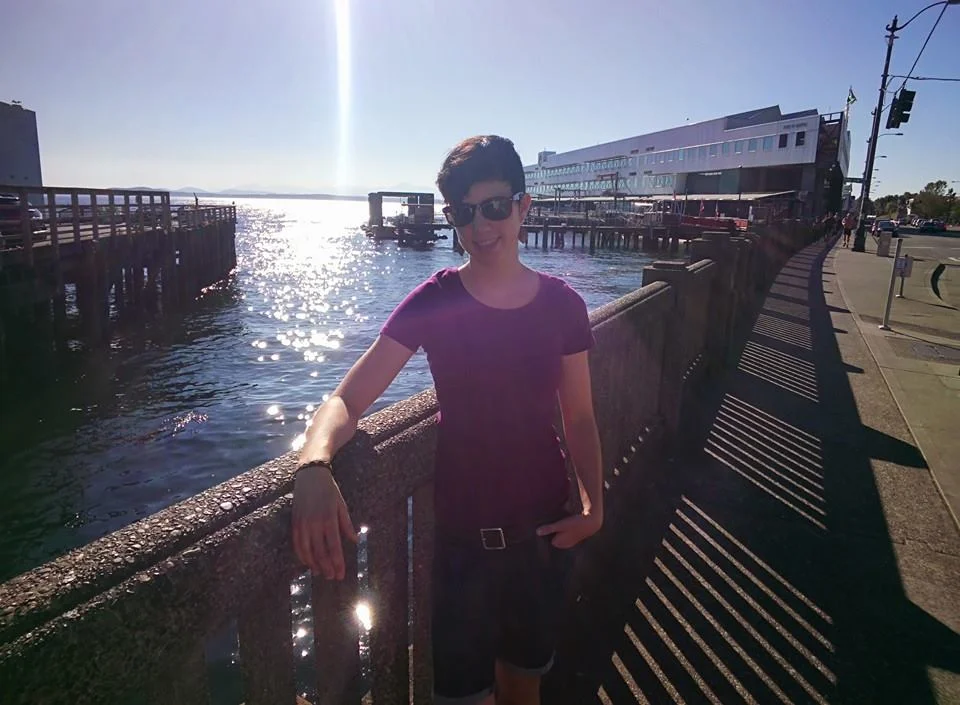
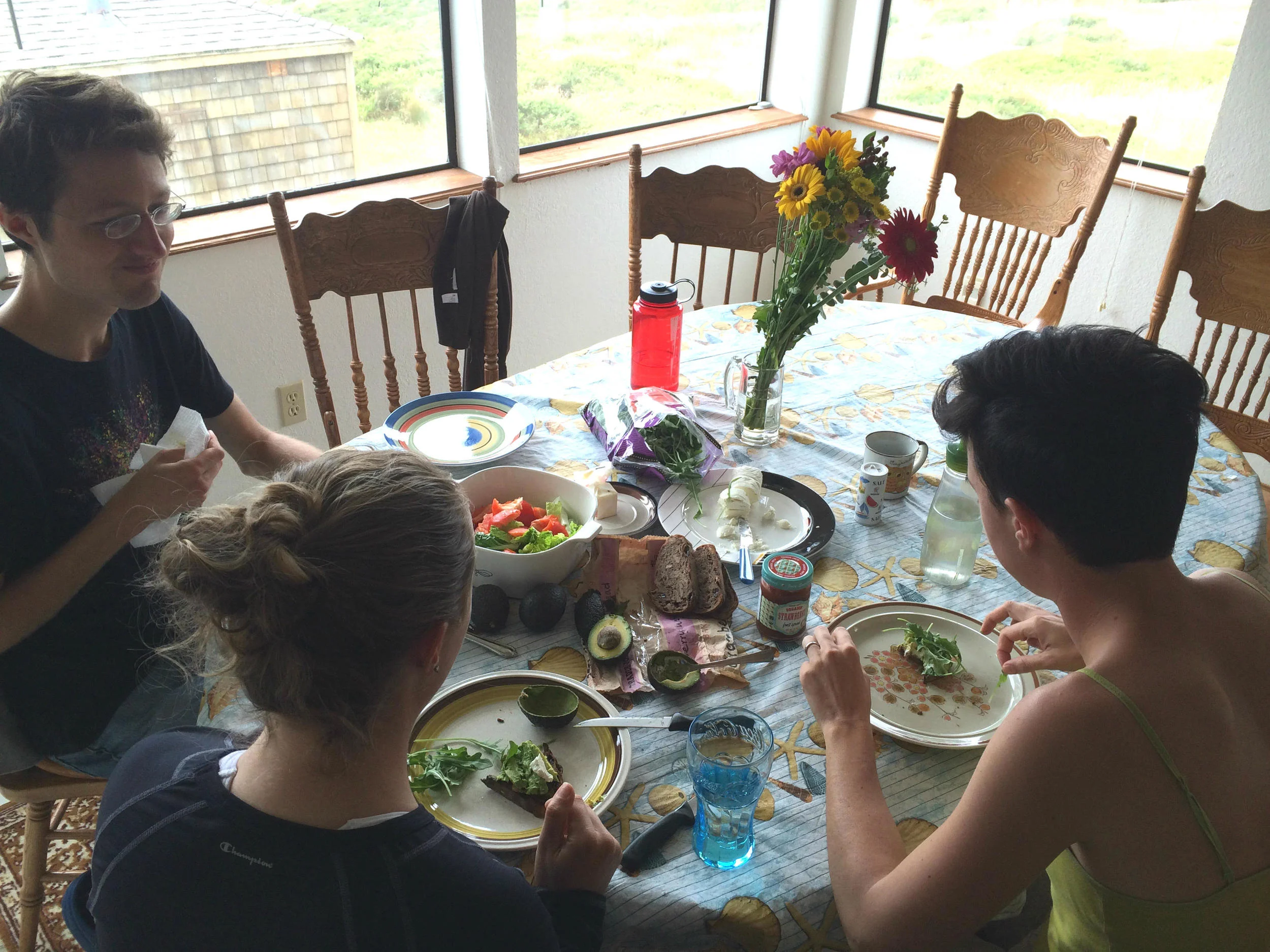
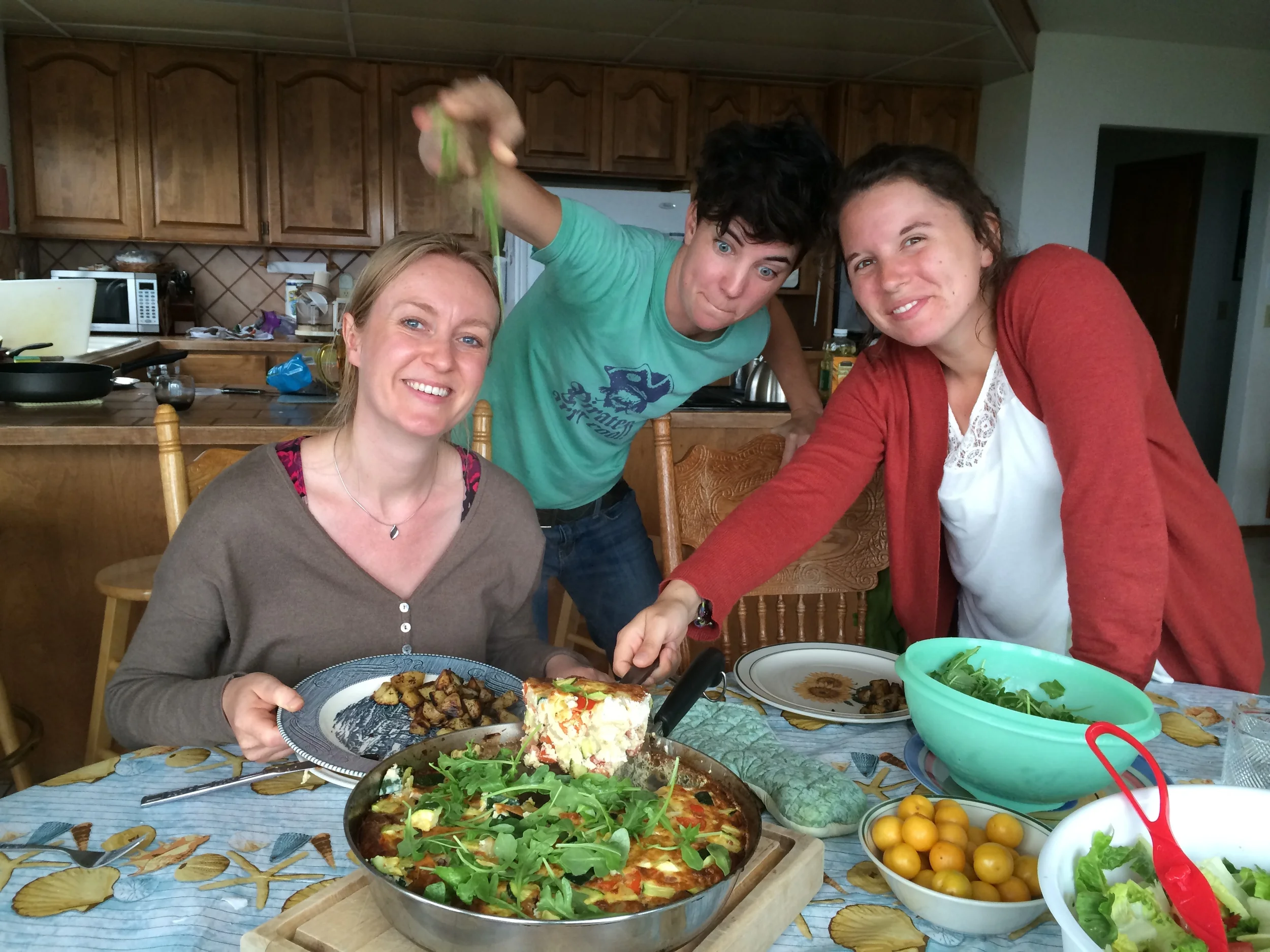
Logan (bottom right) sharing a meal with other YAs during last year's cohort program.
A topic that often comes up during retreat meal times, prompted by the wonderful meals themselves, is vegetarianism. Now, despite being brought up as a cattle rancher in west Texas, I have never been a big meat lover (much to my steak-loving father and grandfather's chagrin). Sure, I ate a diet very much like every other little Texan, but I never really craved meat or thought it sounded appealing. When I went off to college, at a small liberal arts college in north Texas, my horizons, as they are prone to do in such circumstances, expanded. For the first time in my life I met people who identified with spiritual traditions other than Christianity– Muslims, Hindus, Buddhists and atheists became my friends. I also met my first vegetarians, two people who would become some of my best friends, and who also, coincidentally, practiced Buddhism and meditated daily.
After taking a couple environmental studies courses, I decided to make that my major. The things I learned in those classes coupled with the influence of my dear vegetarian friends, prompted me to adopt a largely vegetarian diet. This was easy at school – the cafeteria had delicious vegetarian options and a huge salad bar. At restaurants I quickly learned to navigate menus, paring them down to their vegetarian options, which also made decision making easier. On visits home to west Texas, an area of the world where vegetarianism largely remains an enigma to be feared or ridiculed, eating out was a bit more challenging. I took to cooking much more often for my family and while they appreciated the "unique" and "interesting" food I prepared for them, my father always gruffly asked, half-jokingly, "where's the meat?"
You may have noticed that I said I adopted a "largely vegetarian diet." I almost exclusively ate vegetarian, but I made exceptions. If someone else was preparing a meal for me I graciously ate whatever they offered. Or if someone took me out and treated me to a meal, I gratefully accepted their meal choices. My boyfriend, Thomas, now husband, who is a fabulous cook, also adopted a largely vegetarian diet due to the influences of our friends, but he would occasionally want to cook a meat dish, and I would acquiesce to his desires. I began to call myself a "situational vegetarian," defined by me as someone who chooses vegetarian food when possible but makes exceptions in certain situations.
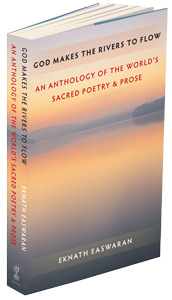
I continued to eat this way after college when Thomas and I moved to Pittsburgh. Shortly after this move I discovered passage meditation and have been practicing ever since. A vegetarian diet jived well with the principles of the practice and Easwaran mentions it fairly often in his talks and writings as an ideal to work towards. Thus, I was encouraged to continue my mostly meatless eating.
That summer, I lived and worked on an organic vegetable farm owned and operated by a staunch vegan and animal rights activist. There I experienced the opposite extreme of the eating spectrum from what I had grown up with in my cattle-ranching family. But I maintained my personal "situational vegetarian" philosophy.
When summer ended, Thomas and I moved to Italy where I lived and worked on a traditional farm. In that experience, I found myself in the perfect center of the meat eating vs. no meat eating spectrum. Mario, the farmer, lived like Italians had lived for centuries before – he grew almost all of his own food, bartered with neighboring farmers for goods and services he couldn't produce himself and let nothing go to waste. It was an almost entirely self-sustaining enterprise and I was full of awe and admiration for him and his lifestyle. At Mario's farm, my situational vegetarianism came to include more meat than I'd eaten in years. He was the best cook in the world (as far as my experience has yet shown) and 90% of the food on the table came from his farm, by his (and our) labor. Unlike in America where food waste is built into our eating culture, Mario wasted nothing.
In the years since, my situational vegetarianism has remained my eating philosophy. At retreats it can sometimes feel as though vegetarianism is a requirement for being a passage meditator. If you aren’t vegetarian, and new to the practice, you may feel a certain embarrassment when you hear other retreat attendees at the table discussing their years of strict vegetarianism. Sometimes I struggle with this and over the years I have found myself to be a more strict vegetarian than at other times. Thomas' vegetarianism was abandoned by our senior year in college and while he respects my eating habits, he is the cook in the household and I at least respectfully and gratefully taste all his culinary creations.
I have made my peace with my lax vegetarianism for now. I see situational vegetarianism as a path towards a goal, a way to balance likes and dislikes and as a way to put others first (those cooking or footing the dining bill or who are uncomfortable or offended by vegetarianism). It is representative of my broader spiritual practice. Flexibility, I have learned, makes for more graceful, patient living. There are and always will be times when our lives are in upheaval and this will affect our spiritual practice. Allowing myself to adjust and tweak and change my practice accordingly is what makes it such a practical and sustainable tool for living. Giving ourselves the permission to be flexible means we do not stagnate or crumble, but progress along our path at our own pace, in our own way.
I greatly admire and respect those who are strict vegetarians. I like hanging out with them because I know the situation will call for vegetarian eating. Some day I will likely be one of them. But one of the most comforting things about this practice is knowing that we are all in this together, everyone does it a little differently, everyone is taking part in this grand experiment and trying different approaches, figuring out what works for them, knowing that what works for them might change, and that that's okay, too. I like crunchy peanut butter, my roommate says that smooth is better, but we both think Easwaran is really cool.