A Passage for May

YA-SF

After memorizing a passage and using it in meditation, it's always gratifying when those passages come to mind during the day, illustrating how much these passages become entwined in our lives. In her post last month, Sara shared a line from the passage "Grieve Not" by Ravidas, and it was a lovely way to show how these texts resonate throughout our lives. After Sara's story, we thought "Grieve Not" would be the perfect passage for May.

We encourage you to add this passage to your rotation this month, and it's nice and short so if you don't know it yet - go for it and memorize!

We'd also love to hear of a time when a passage reflected itself in your daily life. In the comments below, share a story, or a passage, that you have found resonating in your day-to-day life.


Grieve Not – Ravidas

Grieve Not is the name of my town. Pain and fear cannot enter there, free from possessions, free from life’s taxes, free from fear of disease and death.

After much wandering I am come back home where turns not the wheel of time and change, and my Emperor rules, without a second or third, in Abadan, filled with love and wisdom.

The citizens are rich in the wealth of the heart, and they live ever free in the City of God. Listen to Ravidas, just a cobbler: “All who live here are my true friends.”
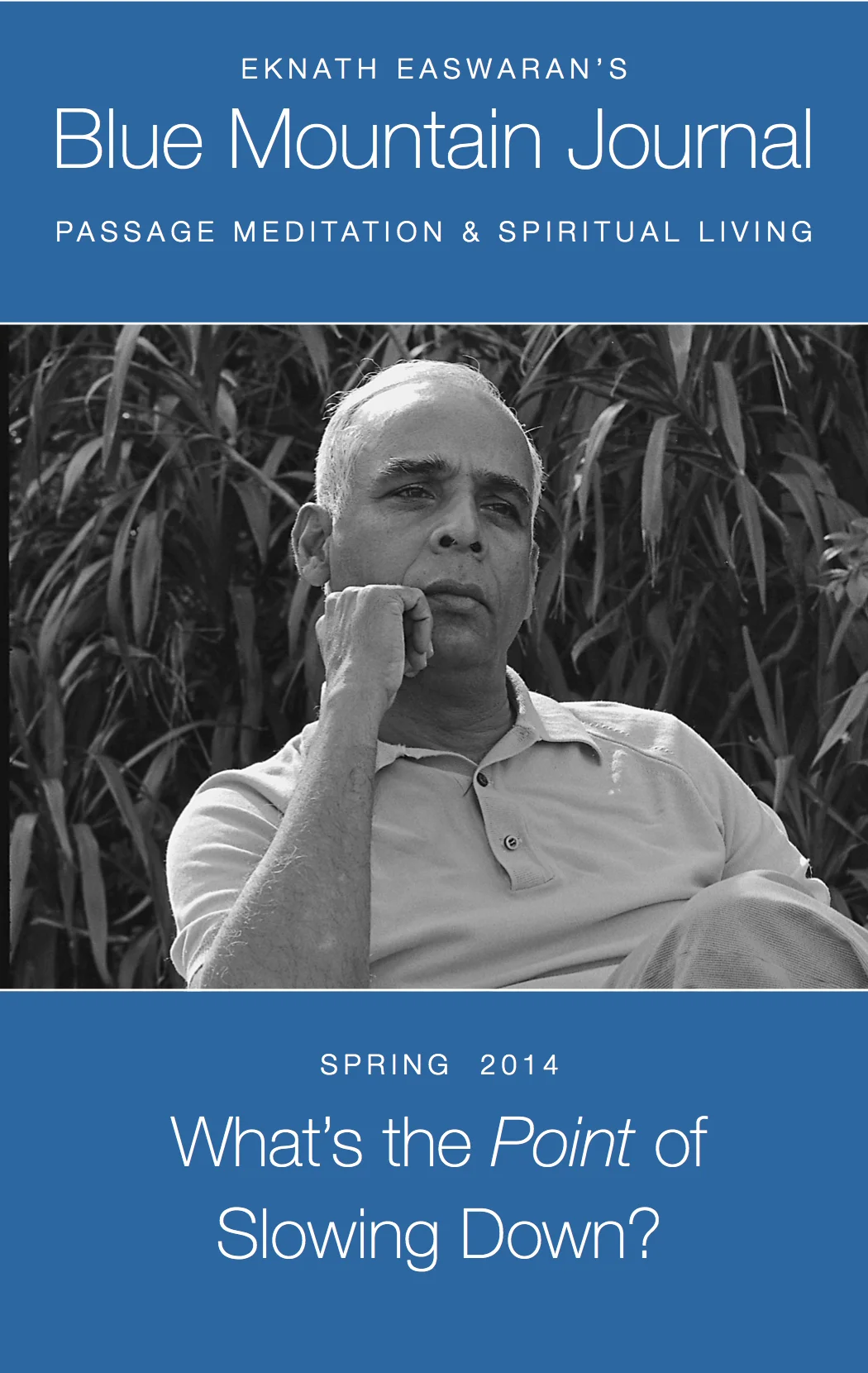

The New BMCM Journal: What's the Point of Slowing Down?

YA-BMCM-Journal-Cover

Just a couple of weeks, ago we here at YA Blog Headquarters got our hands on the most recent edition of the Blue Mountain Journal, and we were immediately drawn in by the new cover and, of course, all the articles inside. After reading it cover to cover (and a few articles more than once!), we wanted to share this invaluable free resource with the YA Blog community.

For over five decades, the Blue Mountain Center of Meditation has been publishing a journal with articles by Easwaran on passage meditation and the other points, as well as stories from passage meditators around the world. Obviously, the journal has undergone a variety of looks and formats since its beginning in the 1960s, and this past month the editorial team at the BMCM issued the latest journal in a brand new format.

We asked the editors about the reasoning for the new format, and learned that the changes were all made to help support us, Easwaran's audience! The new format of the journal has articles of varying lengths, so no matter how much time we have, we can get a little spiritual nourishment. Visually, the new design is not only keeping with the timeless simplicity of Easwaran's work, but it's also beautiful and easy-to-read in print and in the digital version on tablets and smart phones. Also, a YA Team favorite, the Q&A section, is right up front. This edition starts off with the question "Quite honestly, I don't see the point of slowing down. Could you explain why you attach so much importance to it?" Phew. Jumping right in!

Journal Inside Photo.jpg

The journal is available in a print and digital version, and has 9,400 subscribers to the print version, and 4,000 subscribers to the email version. Both versions of the journal are free in the US, and the digital version is free worldwide. Hopefully we've enticed you with that question on slowing down – each time we read that question we're drawn right back in! You can read Easwaran's answer yourself by downloading a digital copy and can even subscribe to the journal.

Before we leave you to read through the new journal, the journal editors are interested in hearing from the YA Blog audience! Following this edition on slowing down, each edition will focus on a single point and next is one-pointed attention. The editors would love to hear questions you might have on the topic! Share your thoughts in the comments below:

  • What question do you have about one-pointed attention that the journal could address?
  • Share a line, or aspect, of the current edition on slowing down that was particularly meaningful to you.
  • Anything else?


From Reading to Living: Exploring My Spiritual Heritage

Meet Nikhil, a YA from White Plains, New York. Nikhil shares how reading Easwaran's translations and commentaries on Indian scriptures led him to integrate his heritage of Indian spirituality into his day-to-day life.

Sri Easwaran's stories and commentaries took me on a much-needed journey to explore the breadth and depth of Indian spirituality. India has a rich history of mystics and teachings. Though all of it is accessible, the meaning of these teachings is widely misinterpreted by most people. I grew up amidst all this wisdom but the scriptures had little impact on me. My idea of religion and spirituality was going to the temple a few times a year to "ask" God for something for myself. Sri Easwaran's teachings made spirituality accessible, so I can incorporate his and other mystics’ teachings in daily living. Each commentary fueled my desire to read more and slowly begin my own transformation.

2014-04-22 21.25.04.jpg

It began in the weakest moment of my life. I had the habit of running away from difficult life situations and each time I ran, the situations came back to haunt me. During one of those moments, I happened to pick up Gandhi the Man at a bookstore in Kolkata, India. The way Sri Easwaran described Gandhi's fears and transformation seemed like he was speaking to me. I was moved enough to read deeper about Sri Easwaran and practice the eight-point program.

Mahatma Gandhi and Sri Easwaran led me to the Bhagavad Gita. I had heard of the Gita but for the first time, I read Sri Easwaran's version seriously. I started understanding that there is more to life than the senses and the material world. As mentioned in the foreword to the Bhagavad Gita – "We spend our days in the familiar world of the five senses but what lies beyond that, if anything, we have no idea". The Gita helped me explore this world beyond. I started understanding the concepts of Dharma, Gunas, Karma, Selfless Service and the Supreme Goal. Essentially, the meaning of life was unfolding right before my eyes. I understood that I was responsible for everything that was happening to me, and I could change my life situation by changing myself. I finally understood why situations I ran away from kept coming back and how I could fix that.

The best part of Sri Easwaran’s commentaries is that he uses examples from different mystics to convey the teaching. As I started reading more, Sri Easwaran introduced me to the teachings of the Buddha and Sri Ramakrishna. Understanding how similarly these mystics describe the purpose of life, the power of concentration, will power, training the mind, and selfless service, removed all doubts in my mind about the truth of these teachings. The Buddha's teaching that "All we are is the result of what we have thought" reinforced for me the idea that I could change my situation by changing my thoughts.

YA-Book3
YA-Book2
YA-Book1

These pages from Easwaran's translation of the Bhagavad Gita (top left) and his commentary on it (right, bottom left) contain passages that particularly inspired Nikhil.

Sri Easwaran has led me to explore the teachings of Mahatma Gandhi, Swami Vivekananda, Sri Aurobindo, Mother Teresa and Sri Ramakrishna among many others. He inspired me to visit Sri Ramakrishna's temple in Kolkata where I had the chance to passage meditate. I have to admit, I was overwhelmed. All this knowledge but where do I start, how do I apply, and how long will it take? I continue to draw inspiration from all mystics, but I realized that Sri Easwaran's Classics of Indian Spirituality capture the essence of all teachings. I don’t need to read every text out there till I focus on understanding and applying in my daily life the principles of a few.

So now I use the Bhagavad Gita, The End of Sorrow, and other Easwaran's teachings as my daily guide in life. Mahatma Gandhi and the Buddha are my role models for how to live these principles. I look forward to reading The Dhammapada in the near future to keep deepening my knowledge. I thank Sri Easwaran and all the community around me for starting my new life and making spirituality accessible to me through his teachings.  I pray that we all become instruments to serve and spread Sri Easwaran's teachings far and wide.

2014-04-22 21.26.00.jpg